PHV Emissions Standards 2026: ZEC Replacement Rules
PHV emissions standards for London PHV drivers. Learn when a replacement vehicle must be ZEC, what TfL checks, and call 020 4577 1120.


🔍 QUICK ANSWER
If your private hire vehicle is being licensed by TfL for the first time, it must be zero emission capable and meet Euro 6. If the vehicle is already licensed by TfL, the key question becomes whether it still fits TfL's age and re-licensing rules, not whether it is newly ZEC-compliant.
- First-time licensed PHVs in London must be ZEC and Euro 6. (Transport for London)
- Fully electric and hydrogen fuel-cell vehicles meet TfL's first-time licensing rule. (Transport for London)
- Already licensed TfL PHVs follow the age-based re-licensing rule. (Transport for London)
- Before buying or accepting any replacement vehicle, check the licensing history, V5C details, CO2 data, and zero-emission capability. (GOV.UK)
- After a non-fault accident, the wrong replacement can cost you time, income, and licensing progress.
Need practical help after a non-fault accident?
Call 020 4577 1120 or WhatsApp 07585 300 600. Accident Assist Network can guide you in English, Romanian, Urdu, Tamil, and Hindi.
You are probably searching because you cannot afford to guess. Your car may be off the road, your work depends on staying compliant, and the advice you are hearing sounds confident but contradictory. That is a bad combination when every day without the right vehicle hits your income. I understand why this feels urgent. This guide clears up the real TfL rule, shows you how to check a replacement vehicle properly, and explains where Accident Assist Network becomes useful after a non-fault accident. Keep reading, because the biggest mistake PHV drivers make here is assuming “replacement” means the same thing in TfL's system as it does in everyday speech. (Transport for London)
Because Asking is the first step
What does Accident Assist Network do and how can it help me right now?
That matters when your income depends on getting back into a workable, licensing-appropriate position.
Learn how Accident Assist Network supports drivers after a non-fault accident
🎬 Watch video guide about PHV emissions standards and ZEC replacement rules
Watch the video guide for a clear overview of PHV emissions standards, ZEC rules, and how to check a replacement vehicle properly.
What Do TfL's PHV Rules Actually Say?
How does TfL define ZEC for PHVs?
If a PHV is being licensed by Transport for London for the first time, it must be zero emission capable and meet Euro 6. If the vehicle is already licensed by TfL, the age rule at re-licensing becomes central instead. (Transport for London)
Transport for London states that since 1 January 2023, all PHVs licensed for the first time must be zero emission capable and meet the Euro 6 emissions standard. TfL also states that PHVs already licensed by it must be no older than 10 years at the time of re-licensing. Fully electric and hydrogen fuel-cell vehicles meet the first-time licensing requirement automatically. (Transport for London)
That distinction is the backbone of this topic. Many drivers hear “PHVs must be ZEC” and assume every replacement option now has to meet the same first-time test. TfL's wording is narrower than that. The real decision point is the vehicle's licensing status in TfL's system. That is why two cars that both look sensible on paper can sit under different rule paths. (Transport for London)
| Situation | Main Rule | What You Check First |
|---|---|---|
| Vehicle new to TfL PHV licensing | ZEC + Euro 6 | CO2, zero-emission range, fuel type |
| Vehicle already licensed by TfL | Re-licensing age rule | Age and licensing history |
That takes you straight to the practical question most drivers actually care about: when you say “replacement,” which rule path are you really stepping into?

Does Every Replacement Vehicle Need To Be ZEC?
Does “replacement” always mean first-time licensing?
No. A replacement vehicle only falls under the first-time ZEC rule if that vehicle is being licensed by TfL for the first time. If it already has TfL PHV licensing history, the age-based re-licensing rule is the first thing to check. (Transport for London)
This is where weaker guides become misleading. You may be replacing your working car, but TfL does not assess your personal situation first. It assesses the vehicle's regulatory status. That means a car can be a “replacement” for you in business terms while still being treated as a first-time licence application in licensing terms. The reverse can also be true with an already licensed vehicle. (Transport for London)
Imagine a London PHV driver whose current car is written off after a non-fault rear-end collision. One option is a vehicle already licensed by TfL before. Another is a used hybrid that has never been licensed by TfL at all. Those two choices are both replacements in everyday language, but not under the same TfL test. That is the reason so many drivers lose time after relying on general dealer wording or forum shorthand. (Transport for London)
- Ask whether the candidate vehicle has ever held a TfL PHV licence.
- If no, treat it as a first-time licensing case.
- If yes, check age and re-licensing eligibility first.
- Then verify emissions and documentation.
Once you understand that split, the next step is checking the vehicle properly before you spend money or accept keys.

How Should You Check A Candidate Vehicle?
What should you verify before committing money?
Before you buy, hire, or accept a PHV replacement vehicle, check four things: licensing history, V5C details, CO2 emissions, and zero-emission capability. If you skip those, you can end up with a car that looks workable in an advert but fails your actual route to legal PHV use. (GOV.UK)
TfL's own pages tell you the first-time licensing rule, but the checking burden still sits with you when you are comparing real vehicles. GOV.UK points drivers to DVLA and VCA tools that help surface registration details and CO2 emissions data. If a vehicle has already been registered, the DVLA enquiry route can help you find the CO2 figure. For newer car fuel and CO2 data, GOV.UK routes you to the VCA's tool. (GOV.UK)
This matters most when you are moving quickly after an accident. A provider can call something “ideal for PCO use,” but that is not the same as proving it fits your TfL path. The safer question is: what evidence supports that claim? The right paperwork is far more useful than a confident verbal reassurance. (GOV.UK)
| Check | Why It Matters | Where To Confirm |
|---|---|---|
| TfL licensing history | Tells you whether first-time ZEC rule applies | Seller, provider, prior TfL paperwork |
| CO2 emissions | Relevant to ZEC thresholds | DVLA / VCA tools |
| Zero-emission range | Needed for some ZEC categories | Manufacturer data / Certificate of Conformity |
| Fuel type / Euro 6 | Baseline for hybrid route | V5C and manufacturer data |
Checking the paperwork is half the problem. The other half is avoiding the standard replacement routes that leave PHV drivers unable to work.

Why Do Standard Courtesy Cars Fail PHV Drivers?
What makes a normal courtesy car unsuitable?
A standard courtesy car may keep you mobile personally, but it often fails the practical test for private hire work. It may not be plated, operator-ready, or aligned with your licensing route. That means you can have a car to drive and still be off the road professionally.
Across the uploaded drafts, this is one of the few points every tool handled well: standard insurer logic and PHV-driver reality often do not match. A family hatchback offered quickly may look helpful on day one, but for a professional driver it can create a second problem. You still need something that works for your actual trade.
That does not mean every insurer offer is automatically useless. It means you need to ask sharper questions before you accept it. If you are relying on app work or operator approval, “replacement” is not enough as a standard. The vehicle has to be suitable for how you earn. That is why PHV drivers describe so much frustration around being “mobile” but still unable to work.
- Is the vehicle operator-ready for your actual work pattern?
- Does it fit your TfL licensing route?
- Are you being told clearly what it can and cannot be used for?
- Have you checked whether it creates added emissions-related costs or compliance issues?
Because Asking is the first step
How does Accident Assist Network arrange a like-for-like replacement vehicle after a non-fault accident?
Clear process matters more than vague reassurance.
See how replacement vehicle support works after a non-fault accident
Off the road and unsure what fits your licensing position?
Call 020 4577 1120, WhatsApp 07585 300 600, or visit Accident Assist Network for calm, practical guidance.
What Should You Do After A Non-Fault Accident?
How do downtime and compliance fit together?
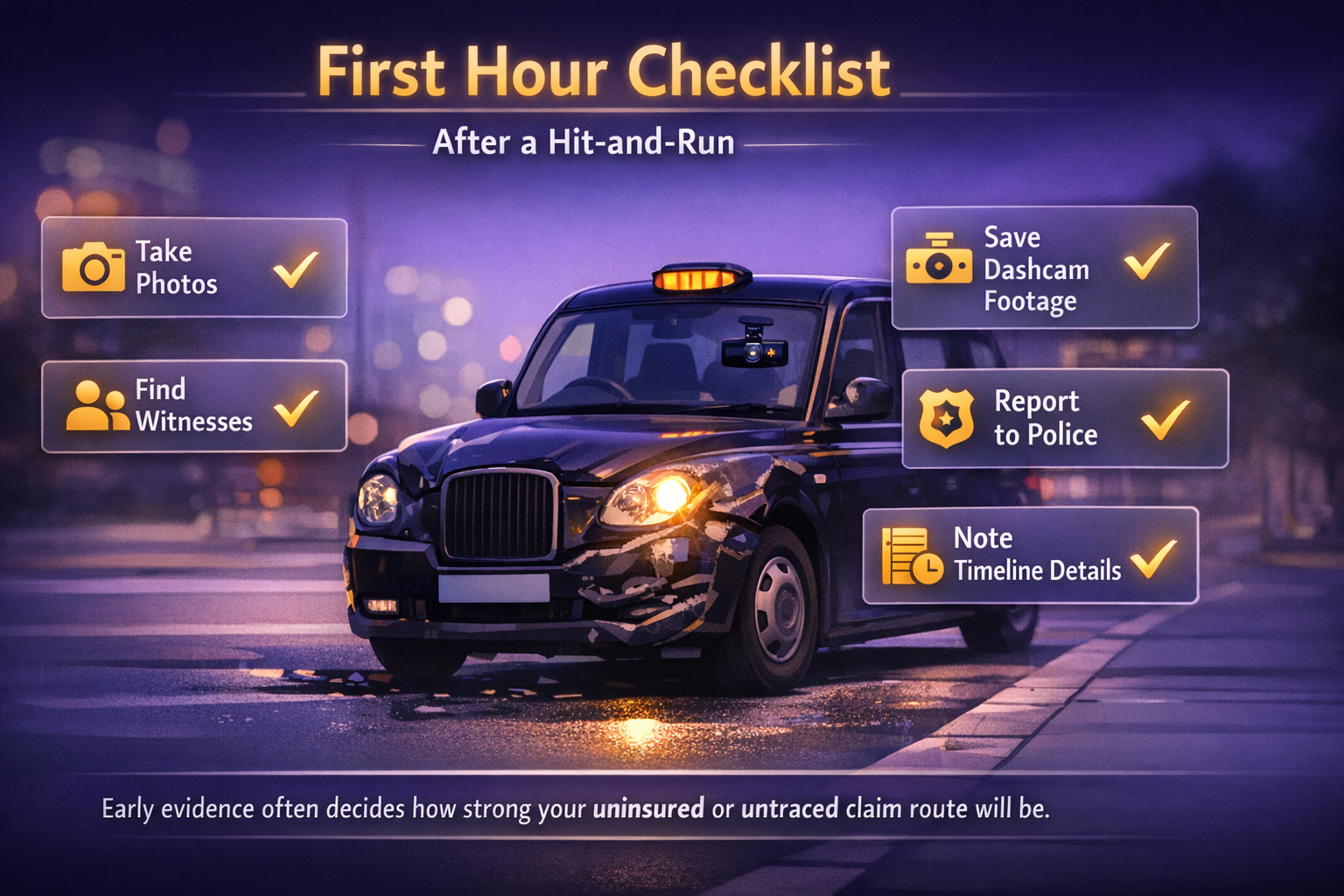
After a non-fault accident, your first priority is safety and evidence. Your second is protecting your ability to work without creating a fresh licensing problem. For PHV drivers, that means thinking about recovery, repairability, and replacement suitability at the same time.
This is where the regulatory question becomes real life. If your working vehicle is damaged, you are not just replacing transport. You are protecting income, trying to limit downtime, and avoiding a rushed choice that makes your next licensing step harder. The most useful mindset is simple: do not treat the next car as just a stopgap. Treat it as a compliance decision as well.
Accident Assist Network's role here stays within the service-scope boundary: vehicle damage only. That means post-accident coordination relating to recovery, repairs, like-for-like replacement support, and practical guidance through independent specialist companies across England. It does not mean personal injury advice, financial advice, or claims guarantees.
- Make sure everyone is safe and gather evidence.
- Confirm whether your vehicle is drivable, repairable, or likely to be off the road for a meaningful period.
- Work out whether you need a temporary work solution or a longer-term replacement decision.
- Check any candidate vehicle against the TfL route that applies to it.
- Read every agreement carefully before signing.
The final step is choosing the replacement path that fits your situation, not the one that just sounds fastest.
Which Replacement Route Makes The Most Sense?
What is the safest decision path in 2026?
The safest replacement route depends on whether you need short-term continuity, a longer-term vehicle decision, or breathing room while repairs or settlement progress. The key is to match the vehicle route to your licensing route, not just your urgency. (Transport for London)
For first-time licensed PHVs, the ZEC and Euro 6 rule is the main gate. For already licensed TfL PHVs, age and renewal status matter first. That means your best next step is not always “find any efficient hybrid quickly.” It is “confirm which regulatory path this exact vehicle is sitting under before you commit.” (Transport for London)
That is also where the hybrid blog improves on the source drafts: it treats the reader's real problem as decision logic, not just product acquisition. A rushed, under-checked choice can leave you with a car that sounds compliant but still slows your return to work. A careful, evidence-based choice protects both your licensing position and your time.
- Short repair period: focus on a workable temporary route that does not create a new compliance problem.
- Long repair or write-off risk: treat the next vehicle as a full TfL-compliance decision.
- New PHV entrant: assume first-time licensing rules apply until proved otherwise.
- Existing TfL-licensed replacement candidate: confirm age and prior licensing history first.
Interactive reflection: If your current PHV went off the road this week, would you know whether your next vehicle was being treated as a replacement in your mind, or a first-time licensing case in TfL's system?
Because Asking is the first step
I'm a London PHV driver and my car is off the road — can I get help finding a compliant replacement without paying upfront?
Clear terms protect you better than rushed assumptions.
See support options for taxi and PHV drivers after a non-fault accident
Need help understanding your next move after a non-fault accident?
Call 020 4577 1120 or WhatsApp 07585 300 600 for practical, no-pressure guidance from Accident Assist Network.
🎯 Your Next 3 Moves
Immediate: Ask whether the vehicle you are considering has ever held a TfL PHV licence.
This session: Verify the registration details, CO2 figure, and any zero-emission capability paperwork. (GOV.UK)
This week: If your current PHV is off the road after a non-fault accident, get practical guidance before signing for a replacement that could create a second compliance problem.
Sources & References
- Source: TfL — Emissions standards for PHVs. Core rule on first-time licensed ZEC PHVs and 10-year re-licensing age rule. (Transport for London)
- Source: TfL — Apply for a private hire vehicle licence. Confirms first-time licensed PHVs must be ZEC and Euro 6, and notes fully electric/hydrogen routes. (Transport for London)
- Source: TfL Press Release (30 Dec 2022). Sets out the published ZEC threshold pathways for first-time PHV licensing. (Transport for London)
- Source: GOV.UK — Get vehicle information from DVLA. Practical route for confirming registration-based vehicle details and emissions-related information. (GOV.UK)
- Source: GOV.UK / VCA — Car fuel and CO2 emissions data. Useful for checking CO2 data when comparing vehicles. (GOV.UK)
Accident Assist Network assists you after a non-fault accident by co-ordinating vehicle recovery, reputable repairs, cash-in-lieu settlements for total-loss vehicles, and like-for-like replacement hire—whether for personal use, licensed taxi work or bike—through our network of independent specialist companies across England. Your one call and we sort it all.
Because our role is one of practical facilitation rather than financial advice, we are not authorised by the Financial Conduct Authority, and our services are not covered by the Financial Ombudsman Service or the Financial Services Compensation Scheme.
Our partner companies will always endeavour to help you recover costs from the at-fault insurer; however, if that insurer delays or disputes payment you may become liable for credit services or other charges set out in your contract. Each partner company will supply its own terms and conditions in agreements. Please read every document thoroughly and, if anything is unclear, ask us—or an independent adviser—before signing. We are happy to guide you in the language you feel most comfortable with.
Need practical help in England? Call 020 4577 1120 | WhatsApp 07585 300 600
Frequently Asked Questions
Does every London PHV have to be zero emission capable in 2026?
How do I know if a car is zero emission capable for TfL purposes?
Can a hybrid still qualify for PHV licensing in London?
Where can I check a vehicle's CO2 emissions before buying it?
What is the biggest mistake drivers make with replacement PHVs?
Can Accident Assist Network help if my PHV is damaged in a non-fault accident?
Because Asking is the first step
Is Accident Assist Network really free, or will I be charged hidden fees later down the line?
Honest explanation is part of protecting your position.
Read how non-fault accident support and fee transparency work
Want a trustworthy friend after a non-fault accident?
Call 020 4577 1120, WhatsApp 07585 300 600, or visit Accident Assist Network.
Raheel A Rathore
Director, Accident Assist Network | 15+ years helping drivers across England understand non-fault accident problems, replacement vehicles, and practical next steps