Loss of Earnings: Taxi Driver Non-Fault Claim Guide (2026)
Self-employed taxi driver off the road after a non-fault accident? Get a plated replacement cab within 24h — 0 upfront cost. Call 24/7: 020 4577 1120.


� QUICK ANSWER
A loss of earnings claim allows self-employed taxi drivers to recover income lost after a non-fault accident — but the fastest way to protect your earnings is to get a like-for-like plated replacement vehicle first.
- As a self-employed driver, you can seek to recover income lost while your vehicle is off the road — this is called a special damages claim, part of your uninsured losses.
- The first step is stopping ongoing income loss by getting a TfL (Transport for London)-plated, PCO (Private Hire/Hackney Carriage)-ready replacement vehicle — so you keep earning while your claim is handled.
- To recover earnings already lost, you will need documentary evidence: your SA302 (HMRC tax calculation), bank statements, and up to three years of self-assessment records.
- Accident Assist Network coordinates your like-for-like replacement vehicle at £0 upfront cost — the fee is deducted after settlement.
- For the legal recovery of lost earnings, you should speak to a specialist road traffic solicitor — this is separate from vehicle coordination.
- Your income clock is running. The section below shows you exactly how to stop it — and what to do about what you have already lost.
Call a trustworthy friend
020 4577 1120. We're here 24/7 to walk you through every step. Your no-claims bonus is protected. WhatsApp 07585 300 600 for immediate support.
Why Taxi Drivers Lose More Than Just a Car After an Accident
What does a grounded taxi actually cost a self-employed driver every day?
Quick Answer: Drivers delay checking their non-fault claim eligibility primarily due to the fear of hidden costs, the anxiety of losing their no-claims discount, and widespread confusion over complex insurance terminology. Many mistakenly believe that seeking independent assistance will automatically result in massive upfront fees or prolonged legal battles.
When an accident happens, the physical impact is often followed immediately by a wave of administrative panic. You are left staring at a dented bumper or a completely undriveable vehicle, wondering how you are going to get to work tomorrow, how you will manage the school run, or—if you are a professional driver—how you will protect your weekly income. Instead of seeking immediate help, many drivers freeze. They hesitate because the UK motor claims system is notoriously difficult to navigate without a guide.
Many drivers on the Honest John forums report immense frustration when trying to figure out if they qualify for a replacement vehicle, often citing confusing and contradictory advice from their own insurers regarding their excess payments. Similarly, one user on Reddit's r/LegalAdviceUK shared a common fear: “I was hit from behind at a junction, but I was terrified to claim because I thought I’d lose my no-claims bonus before liability was officially proven.” This hesitation is incredibly common, but it can lead to unnecessary delays in your mobility and vehicle repair.
According to guidelines from the Financial Ombudsman Service, when an accident is not your fault, you have specific legal rights regarding how your vehicle is repaired and replaced. However, knowing your rights and actually enforcing them are two different things.
Common Fears Holding Drivers Back:
- The Excess Trap: Worrying that you must pay a £500+ excess fee just to get the repair process started, even when you did nothing wrong.
- The Mobility Gap: Fearing that you will be left without a vehicle for weeks, or handed a tiny 1.0L courtesy car that cannot accommodate your family or your professional licensing needs (such as TfL requirements).
- The Premium Penalty: Believing that simply reporting the incident or using an accident management service will automatically cause next year's insurance premiums to skyrocket.
- The Language Barrier: Struggling to understand dense policy documents written in complex legal English, leading to a fear of signing something you don't fully comprehend.
Skip this eligibility check, and your vehicle recovery timeline can easily extend by weeks. Let's prevent that by looking at the specific rules. →
🎬 Watch video guide about loss of earnings and taxi driver claims
Watch the video guide for a clear overview of non-fault support, your rights after a collision, and the steps to protect your claim.
Because Asking is the first step
How do I check if I qualify for non-fault accident support?
What Is a Loss of Earnings Claim? Plain English for Drivers
What are the exact criteria to qualify for non-fault accident support?
Yes — as a self-employed taxi driver, you can seek to recover income lost as a direct result of a non-fault accident. In UK motor law, this falls under special damages — a category of financial loss that is specific and calculable. It forms part of what is known as your uninsured losses: costs and losses the at-fault driver's insurer should cover, beyond just the vehicle repairs.
Special damages are distinct from general damages, which cover pain and suffering in a personal injury context. For a self-employed taxi driver, special damages on the vehicle damage side can include: Loss of income during the period your vehicle was undriveable; Vehicle hire costs if you sourced a replacement at your own expense; Recovery and storage fees if you paid for vehicle recovery from the scene; Excess payments made to your own insurer, if applicable.
It is important to be clear about where different services begin and end. Accident Assist Network coordinates vehicle recovery, like-for-like replacement hire, and repairs — this is vehicle damage coordination only. The legal recovery of your actual lost earnings is handled by a specialist road traffic solicitor. These are two separate processes, and both can run at the same time.
Key terms explained plainly:
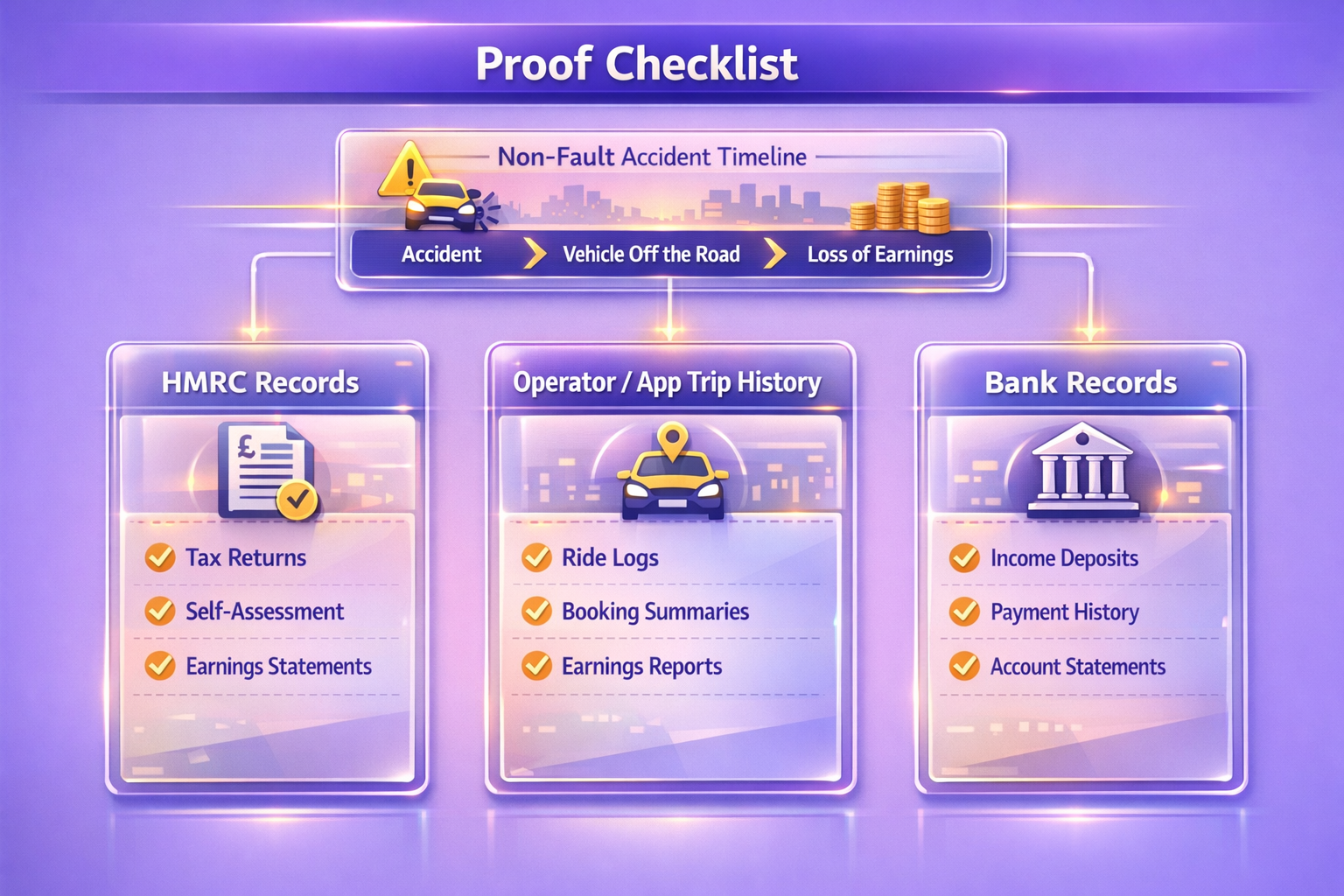
Income impact by situation for self-employed taxi drivers
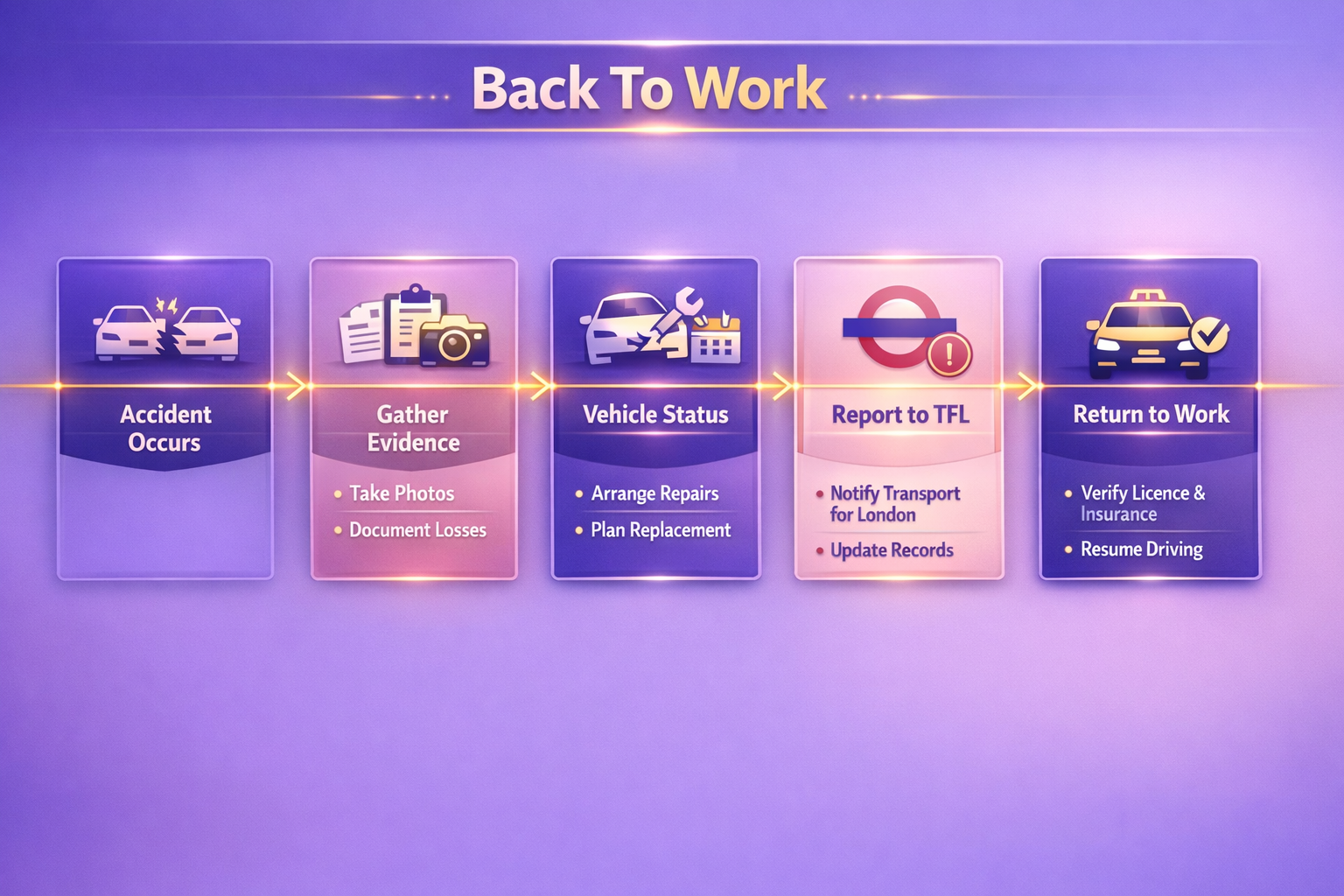
Documentation needed to prove earnings loss
The 60-Second Eligibility Checklist:
- Liability: Did the other driver cause the collision? (Yes/No)
- Identification: Do you have the at-fault vehicle's registration number? (Yes/No)
- Insurance: Is the at-fault vehicle insured? (Yes/No - Note: If unsure, this can often be checked via industry databases later, provided you have the registration plate.)
- Damage: Is your vehicle damaged and in need of repair or replacement? (Yes/No)
- Location: Did the accident occur within England? (Yes/No)
The next section explains a critical distinction that many taxi drivers only discover too late: the difference between income you can still protect today and income you have already lost.
Because Asking is the first step
Can I support a loss of earnings process as a self-employed taxi driver if I have no payslips?
Two Types of Income Loss: Stopped vs Already Gone
What is the difference between ongoing income loss and earnings already missed?
When your taxi is off the road, your income loss falls into two categories. The first is ongoing loss — income you are losing right now, every day your vehicle is unavailable. This can be stopped by getting a like-for-like plated replacement vehicle as quickly as possible. The second is already lost earnings — income from the days between the accident and receiving a replacement. These must be documented and recovered through a formal uninsured losses process.
This distinction matters enormously — and it is where many taxi drivers lose money they did not need to lose.
Imagine this scenario (fictional — for illustration only): A self-employed PHV driver — let us call him Hassan — has his vehicle rear-ended at a rank. His car is undriveable. He calls his own insurer, who tells him a courtesy car will arrive in four days. Hassan accepts this, not knowing the vehicle will not be PCO-licensed. He spends four days unable to work legally. When the replacement finally arrives, it is the wrong vehicle type. He ends up off-road for seven days in total.
Every one of those seven days is a loss that was, at least in part, preventable. Had Hassan understood his entitlement to a like-for-like plated replacement from the point of the accident — and known where to coordinate it — the gap could have been significantly shorter.
How the two loss types are handled differently:
| Loss Type | What It Is | How It Is Addressed |
|---|---|---|
| Ongoing income loss | Earnings you are losing each day without a plated vehicle | Coordinate a like-for-like replacement immediately |
| Already lost earnings | Income from days already missed since the accident | Document with SA302, bank statements, and tax records — then present via a specialist road traffic solicitor |
Understanding that these are two separate problems — each with its own solution — is the foundation of protecting your income after a non-fault accident. The next section covers exactly what evidence you will need to prove what you have lost.
How to Prove Your Earnings as a Self-Employed Taxi Driver
What documents does a self-employed driver need to evidence lost income?
To support a loss of earnings process after a non-fault accident, a self-employed taxi driver needs to demonstrate their regular income through HMRC-accepted records. The core document is your SA302 — HMRC's official tax year overview and calculation for self-employed individuals. Alongside this, up to three years of self-assessment records, bank statements, and profit and loss accounts are typically required to calculate a fair average income figure. (SOURCE: GOV.UK, Get your SA302 tax calculation)gov
This is where many self-employed drivers find themselves under pressure. Unlike an employed worker who can produce payslips, your income may vary week to week and season to season. Being prepared with the right documentation makes a significant difference when the process begins.
Your 6-Step Income Evidence Checklist:
| # | Document | What It Proves | Where to Get It |
|---|---|---|---|
| 1 | SA302 (Tax Calculation) | Annual income as declared to HMRC | HMRC online account or your accountant |
| 2 | Tax Year Overview | Confirms self-assessment filing and income period | HMRC online account |
| 3 | Bank Statements (3–6 months) | Consistent earnings pattern and regular deposits | Your bank |
| 4 | Profit & Loss Accounts | Business income vs expenses — net earnings figure | Your accountant |
| 5 | 3 Years of Self-Assessment Records | Income averaging — stabilises seasonal variation | HMRC online account |
| 6 | TfL/PCO Licence Copy | Confirms you are a licensed professional driver | TfL licensing portal |
Important for 2026: Under HMRC's Making Tax Digital programme, self-employed taxi drivers earning above £50,000 per year must file quarterly digital records from April 2026. (SOURCE: Taxi Point, Four quarterly tax reporting dates taxi drivers must not miss) Keeping your records updated quarterly means your income evidence will always be current — not scrambled together in a crisis.taxi-point
Myth to break: "I can only support a claim if I have regular monthly payslips." This is false. Self-employed drivers are specifically accommodated in UK motor claims practice. Your SA302, combined with bank statements and tax records, is the accepted standard of proof. (SOURCE: Sigma Chartered, What is SA302?)sigmachartered
Armed with the right documents, you are in a strong position. But there is one costly mistake that can undermine all of this preparation — and it is far easier to make than most drivers realise.
Because Asking is the first step
How quickly can I get a replacement vehicle after an accident?
Your Rights as a Self-Employed Driver After a Non-Fault Accident
What rights does a self-employed taxi driver have after a non-fault accident in England?
As a self-employed taxi or private hire driver in England, a non-fault accident does not mean you have to absorb your losses. You have the right to a like-for-like plated replacement vehicle, to seek recovery of your uninsured losses from the at-fault insurer, and to coordinate your claim independently — without going through your own insurer and risking your no-claims discount.
Your rights, set out plainly:
- The right to a like-for-like replacement — not a generic courtesy car, but a vehicle that matches your licensed working vehicle in type and function.
- The right to seek recovery of uninsured losses — including documented lost earnings, recovery costs, and any excess you have paid.
- The right to use an independent accident coordination service — you are not obliged to go through your own insurer.
- The right to clear information — you are entitled to understand every document before signing, and to ask for explanations in your language.
- The right to independent advice — if you are unsure about any part of the process, speak to Citizens Advice, a motor claims solicitor, or a professional driver association before agreeing to anything.
On the multilingual point: Accident Assist Network provides support in English, Romanian, Urdu, Tamil, and Hindi. No driver should be at a disadvantage because of a language barrier.
What Accident Assist Network coordinates on your behalf (vehicle damage coordination only):
Vehicle Recovery
Your taxi or PHV safely collected — no out-of-pocket cost
Like-for-Like Replacement
A PCO-ready vehicle so you can keep earning
Manufacturer Repairs
Your vehicle returned to its pre-accident condition
Cash Settlement
A fair settlement coordinated if your vehicle is written off
All services are coordinated at £0 upfront cost. The coordination fee is deducted from the eventual settlement with the at-fault insurer. If the at-fault insurer delays or disputes payment, you may become liable for costs set out in your individual agreement — full details are explained clearly before you sign anything. For the legal recovery of your actual lost earnings, a qualified road traffic solicitor is the appropriate next step. You can explore the full non-fault accident claims process guide for more detail.
Call a trustworthy friend
020 4577 1120. We're here 24/7 to walk you through every step. Your no-claims bonus is protected. WhatsApp 07585 300 600 for immediate support.
Because Asking is the first step
Is Accident Assist Network really free, or will I be charged hidden fees later down the line?
Your Next 3 Moves
IMMEDIATE — if you are off the road now: Call Accident Assist Network on 020 4577 1120 or WhatsApp 07585 300 600. We coordinate a like-for-like plated replacement and vehicle recovery at £0 upfront cost.
THIS WEEK: Log in to your HMRC online account and download your most recent SA302 and Tax Year Overview. Save them somewhere accessible. Keep them updated.
THIS MONTH: Review your TfL/PCO licence status and confirm your insurance terms cover independent accident coordination — so you know your options before you ever need them.
Call a trustworthy friend
020 4577 1120. We're here 24/7 to walk you through every step. Your no-claims bonus is protected. WhatsApp 07585 300 600 for immediate support.
Frequently Asked Questions
Q1: Can I support a loss of earnings process as a self-employed taxi driver if I have no payslips?
Q2: How long does recovering lost earnings take for a self-employed driver after a non-fault accident?
Q3: What is the difference between uninsured losses and a personal injury matter?
Q4: Will using Accident Assist Network affect my no-claims discount?
Q5: What if I cannot access my SA302 quickly — can I still move forward on getting a replacement vehicle?
Q6: Can a PHV (private hire vehicle) driver seek the same entitlements as a black cab driver?
Q7: What should I collect at the accident scene to protect my position?
Sources & References
- GOV.UK — Department for Transport | Taxi and private hire vehicle statistics, England: 2024 (revised) | https://www.gov.uk/government/statistics/taxi-and-private-hire-vehicle-statistics-england-2024gov
- GOV.UK — HMRC | Get your SA302 tax calculation | https://www.gov.uk/sa302-tax-calculationgov
- Taxi Point | Four quarterly tax reporting dates taxi drivers and self-employed workers must not miss under Making Tax Digital | https://www.taxi-point.co.uk/post/four-quarterly-tax-reporting-dates-taxi-drivers-and-self-employed-workers-must-not-miss-under-taxi-point
- Sigma Chartered Accountants | What is SA302? HMRC Tax Form Explained Clearly | https://sigmachartered.co.uk/guide-to-sa302-tax-form/sigmachartered
- Accident Assist Network | Courtesy Car vs Credit Hire: Why Taxi Drivers Refuse Insurer Offers (2026) | https://accidentassistnetwork.co.uk/courtesy-car-vs-credit-hire-taxi-drivers-2026/accidentassistnetwork.co
- Accident Assist Network | London Taxi Accident Claim — PCO Licensed Hire | https://accidentassistnetwork.co.uk/london-taxi/ (LTDA earnings data cited here)accidentassistnetwork.co
Accident Assist Network assists you after a non-fault accident by co-ordinating vehicle recovery, reputable repairs, cash-in-lieu settlements for total-loss vehicles, and like-for-like replacement hire—whether for personal use, licensed taxi work or bike—through our network of independent specialist companies across England. Your one call and we sort it all.
Because our role is one of practical facilitation rather than financial advice, we are not authorised by the Financial Conduct Authority, and our services are not covered by the Financial Ombudsman Service or the Financial Services Compensation Scheme.
Our partner companies will always endeavour to help you recover costs from the at-fault insurer; however, if that insurer delays or disputes payment you may become liable for credit services or other charges set out in your contract. Each partner company will supply its own terms and conditions in agreements. Please read every document thoroughly and, if anything is unclear, ask us—or an independent adviser—before signing. We are happy to guide you in the language you feel most comfortable with.
Need practical help in England? Call 020 4577 1120 | WhatsApp 07585 300 600
Raheel A Rathore
Director, Accident Assist Network | 15+ years coordinating non-fault vehicle claims and income protection for taxi drivers across England