


London PHV Replacement Vehicle: Post-Crash Driver Checks
This London guide covers the post-crash PHV hand-over without deciding fault, licensing, insurance, eligibility or legal rights.
I turn official London licensing and insurance evidence into a calm hand-over check for PHV drivers returning after a crash.

On this page
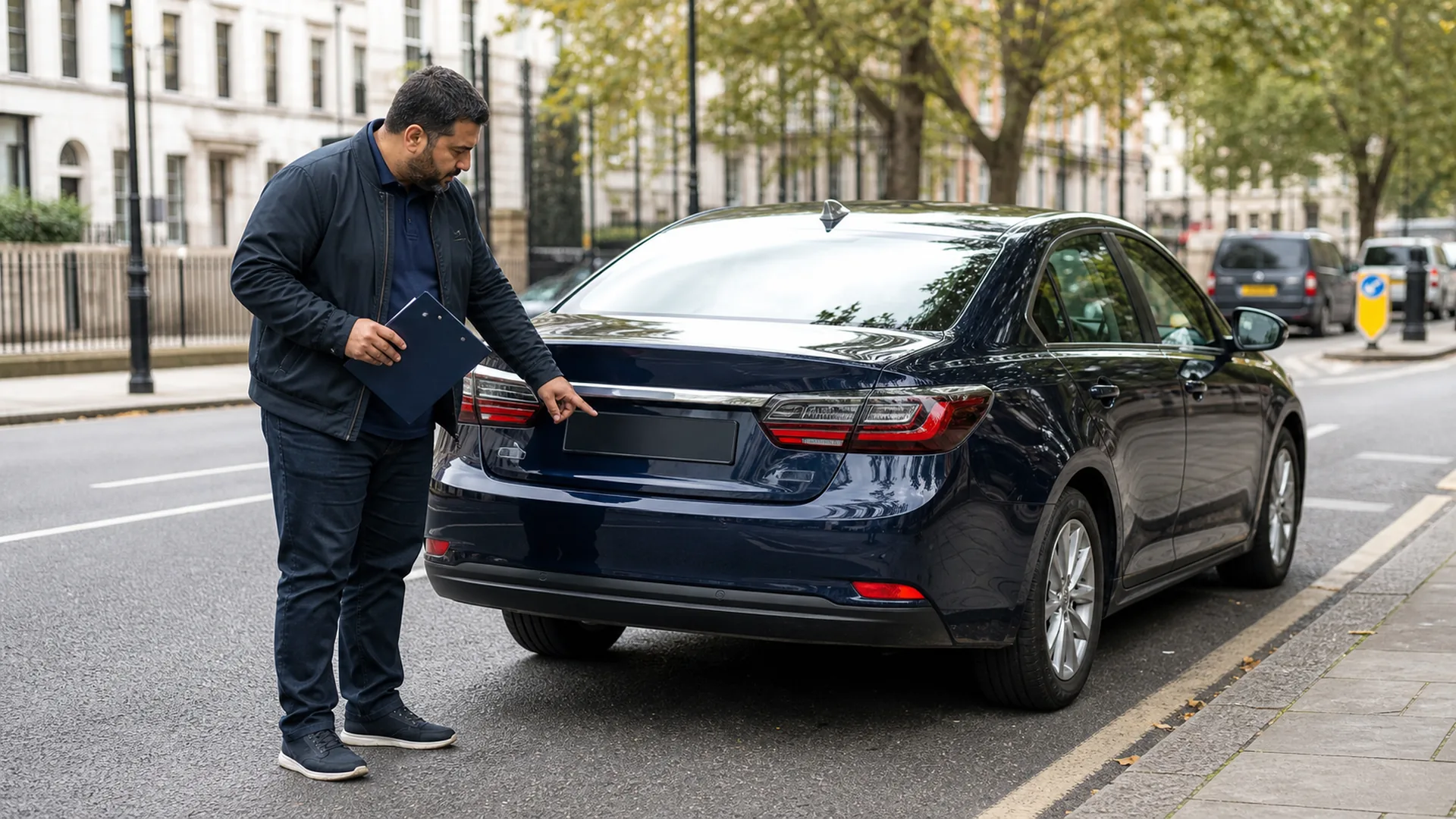
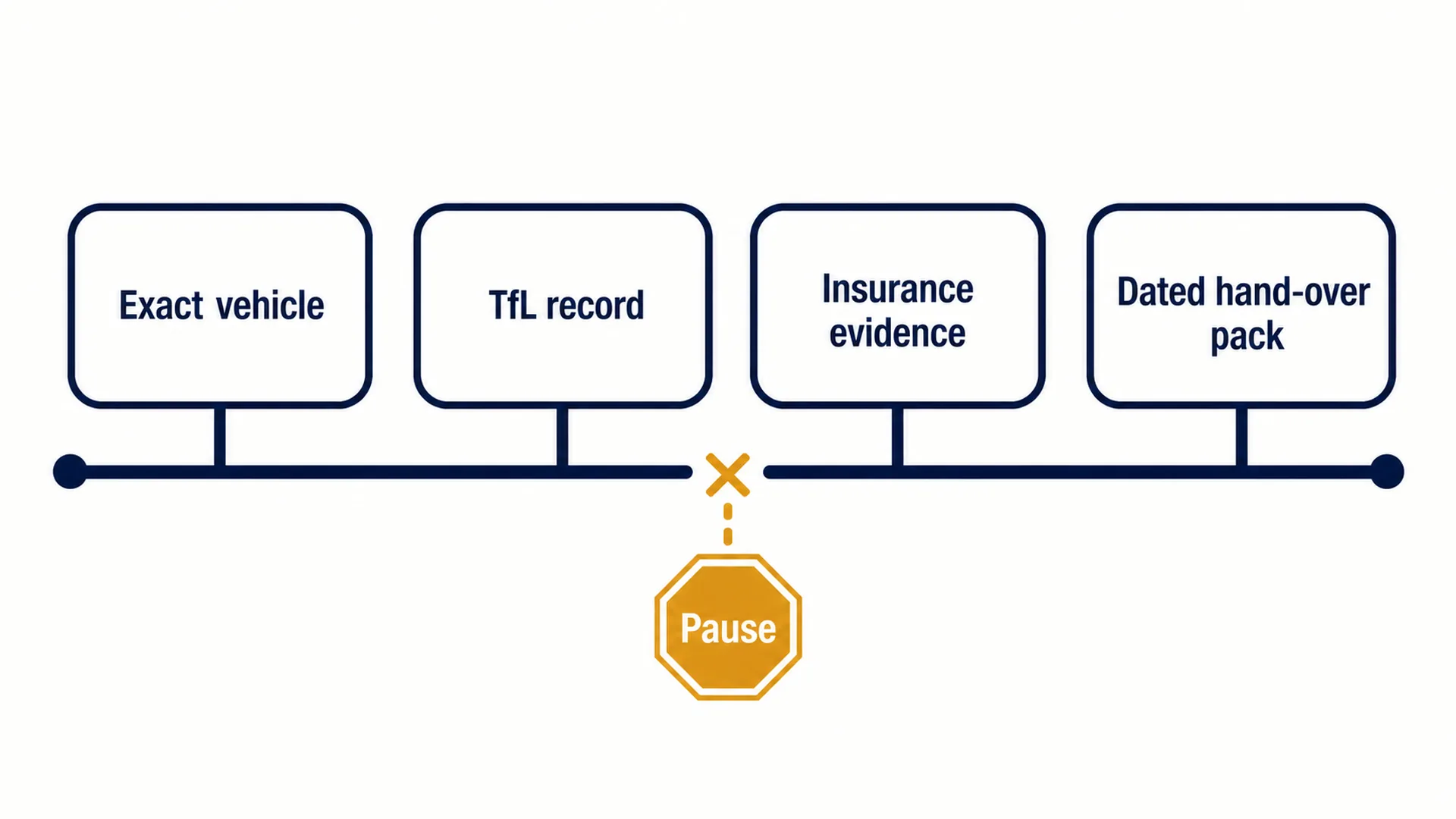
Before using a London PHV replacement vehicle after a crash, match the physical registration to the agreement, check the official Transport for London vehicle record, and obtain current insurance evidence addressing private-hire use and the driver. Keep dated copies of the hand-over, TfL result, policy evidence and corrections. Licensing and insurance are separate checks. If any vehicle identity, status, use or driver detail conflicts, pause, ask the responsible organisation for written clarification and repeat every affected check before accepting bookings.
You may be ready to return to bookings while records arrive from different people. A confident hand-over is not a complete evidence chain. This guide gives London PHV drivers one calm sequence for matching the vehicle, checking TfL information, confirming insurance evidence and keeping a dated pack. Start with the registration; every later check depends on it.
AAN describes coordination of vehicle-damage recovery, replacement vehicles and repairs through third-party providers, subject to eligibility and separate terms. The service overview explains that practical scope. It does not replace the licensing or insurance checks for the exact PHV supplied.
Explore AAN's vehicle support services
Need calm practical coordination after a London crash? Call 020 4577 1120 or WhatsApp 07585 300 600; eligibility and provider terms apply.
Match The Exact Replacement Vehicle
Which vehicle are you actually receiving today?
Start with the physical replacement vehicle. Record its registration, make, model and visible licensing identifiers, then compare those details with the hand-over agreement and every supplied document. If the registration differs anywhere, pause and request corrected evidence before accepting bookings or relying on a later check.
A temporary vehicle may look ready for work while its paperwork refers to another allocation. The registration is therefore the evidence spine: one exact identifier that should connect the car in front of you with the agreement, licensing result, policy evidence and provider messages. Photograph the registration, mileage and relevant displayed identifiers at hand-over. Record the date, place, supplier and agreement reference. Compare every character, because a matching model or colour does not establish that the document concerns this car. If the supplier changes the allocation, begin again with the new registration rather than carrying forward the previous vehicle's records. Keep the original message and the corrected version so the sequence remains clear. This is not a mechanical inspection, a document-authentication service or a legal decision. It is a practical check for obvious identity conflicts before you rely on official or contractual evidence. Ask the issuer to correct any mismatch; do not edit a document yourself. If a file is incomplete, request the complete version and note who supplied it. A coherent vehicle identity also protects the next organisations from being asked about the wrong car. Without that anchor, a genuine TfL result or policy schedule can still be irrelevant to the vehicle you received. The first decision is therefore deliberately simple: can every later item be tied to the same physical registration without guesswork? Check the visible car again after collecting keys today, because a last-minute parking-bay swap can invalidate an otherwise tidy pack assembled for a different allocation.
- Record registration, make, model and visible identifiers.
- Match the agreement and allocation reference exactly.
- Preserve original and corrected versions with dates.
With one vehicle identity fixed, the official London licensing record becomes meaningful.

Verify The TfL Licence Record
How do I check this vehicle with TfL?
Use Transport for London's official taxi and private-hire route for the exact registration. Compare the result with the physical vehicle and agreement, then retain a dated copy showing the source. Treat an absent, unclear or mismatched result as a question for TfL or the vehicle owner, not as something to assume.
Transport for London is the licensing authority for this London-focused check. Search the exact registration through TfL's official route where available, rather than relying only on a forwarded screenshot. Read the wording shown and preserve it without turning it into a broader approval claim. Check that the vehicle identity agrees with the car and hand-over agreement, and save the access date with the page or result. TfL publishes vehicle licensing, documentation, inspection, signage and eligibility information; the vehicle owner is responsible for the application. Those facts explain why a provider can supply documents but cannot replace TfL as the source of the licensing record. If the result is missing or unclear, ask the owner or provider to resolve the point with TfL and retain the reply. Recheck whenever the registration or allocation changes. A licence record also has a defined limit: it does not independently establish the driver's insurance position, the terms of a provider agreement or the outcome of a claim. Keep those questions separate so that one positive-looking record is not stretched beyond its source. Department for Transport guidance recognises that licensing authorities have discretion, so a process used by a council outside London is not proof of TfL status. This article does not declare a vehicle licensed or unlicensed; it explains how to locate, match and retain the responsible public record for the exact London PHV offered. Save enough surrounding context to show what the result actually covered, rather than cropping it into a misleading yes-or-no approval image.
- Use TfL's official route for the exact registration.
- Save the source, wording, access date and result.
- Recheck after any vehicle or registration change.
Licensing answers one question; the driver's insured use requires its own evidence path.
Accident Assist Network may coordinate eligible vehicle-damage recovery, replacement and repair support through separate providers. The provider, TfL and insurer remain responsible for their own decisions. Read the taxi accident guidance for the wider post-crash context, then verify this replacement vehicle's exact evidence.
Read the London taxi accident guidance
If a replacement hand-over is being arranged, ask AAN which provider and terms apply, then complete the independent TfL and insurance checks.
Confirm Insurance For Driver And Use
Does the evidence cover me for PHV work?
Ask for current policy evidence addressing the exact replacement vehicle, private-hire use and your position as driver. A TfL vehicle result does not prove insurance cover. If a certificate, schedule, fleet letter or named-driver confirmation is unclear, obtain written clarification from the insurer or authorised insurance provider before working.
Insurance evidence and a vehicle licence serve different purposes. GOV.UK's taxi vehicle eligibility guidance says insurance must cover public or private taxi hire and include the driver as a named driver. Apply that source carefully to the records supplied for your replacement: check the registration, policy period, permitted use and the way you are identified or connected to the cover. A certificate title alone may not answer every point. If a fleet arrangement is involved, ask what links this driver and this allocated vehicle to the policy, and keep the complete supporting document. Direct uncertainty to the insurer or authorised insurance provider responsible for the evidence; a vehicle supplier can pass on documents but should not automatically be treated as the final authority on cover. Record the name and role of the person answering and request written confirmation where a material detail is not visible. Preserve conditions and exclusions with the page that appears reassuring, because removing context can distort meaning. Do not publish private policy documents or share more personal data than necessary. This guide cannot interpret a policy, confirm that cover applies, or provide insurance advice. Its purpose is to stop three common substitutions: a TfL record standing in for insurance, a generic promise standing in for driver evidence, or a document for another registration standing in for the actual car. The practical threshold is coherent evidence from the responsible source, not confidence created by urgency. Recheck the evidence if its stated period changes before the hand-over is complete.
- Match registration, period and private-hire use.
- Confirm how the actual driver is covered.
- Keep complete evidence and written clarification.
Once licensing and insurance are separate, each remaining question can go to its proper owner.
Separate Each Organisation's Responsibility
Who can confirm each part of the hand-over?
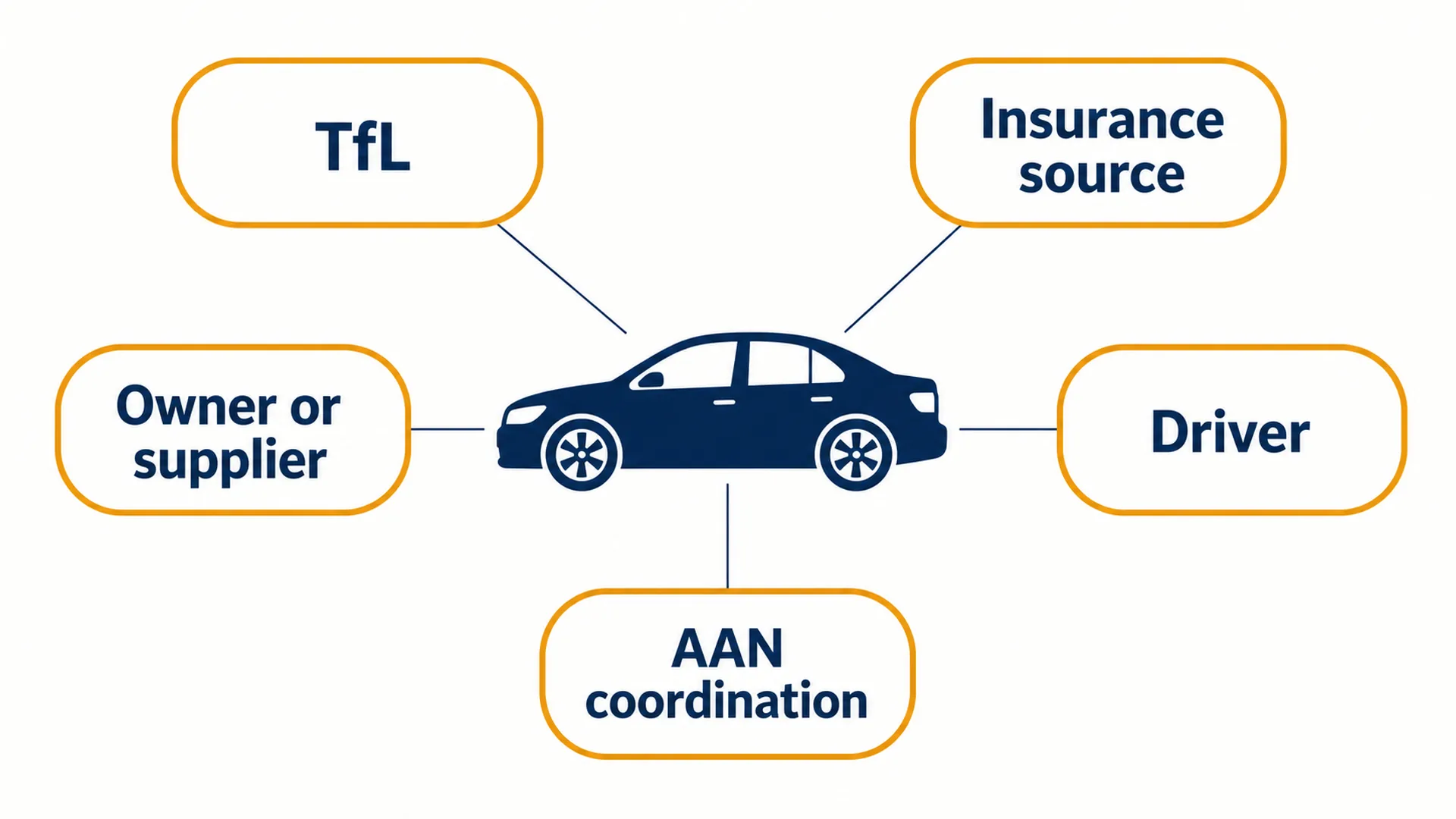
Send each question to its responsible source: TfL for the London vehicle record, the insurer or authorised provider for insurance evidence, the owner or supplier for the allocated vehicle and agreement, and the driver for matching and retaining the pack. A coordinator can organise support but cannot replace those decisions.
A helpful conversation can answer only the question within that organisation's role. TfL publishes licensing information but does not make a personalised insurance decision. An insurer or authorised insurance provider can explain policy evidence but does not allocate the replacement car. The owner or supplier can identify the offered vehicle and agreement, while the driver must compare what is supplied with the physical car. Accident Assist Network may coordinate eligible vehicle-damage recovery, replacement and repair services through third-party providers, subject to separate terms and decisions. That coordination does not make AAN the licensing authority, insurer or legal adviser. When one reply crosses two areas, split the request. Ask TfL about the vehicle record and ask the responsible insurance source about cover evidence. Put both replies beside the same registration in the hand-over pack. If the provider changes the car, ask for a revised agreement and restart the dependent checks. This responsibility map prevents informal reassurance from expanding into a claim its speaker cannot establish. It also makes escalation calmer: describe the exact mismatch, send it to the correct organisation and request a complete response. The process is not about mistrusting every participant. It is about respecting the limits of each source. A clear map also helps an operator or supplier prepare a better hand-over, because the driver can see which document answers which question and which missing answer must be resolved elsewhere. Write each unanswered question beside its owner; this simple separation prevents repeated calls to the wrong party and makes the eventual written reply easier to file.
- TfL: London vehicle licensing record.
- Insurance source: driver, use and policy evidence.
- Owner or supplier: allocation and hand-over agreement.
- Driver: comparison, retention and mismatch record.
The answers become useful only when they are preserved as one dated, readable pack.
TfL is the source for the London vehicle-licensing record, while the insurer or authorised insurance provider must address policy evidence. AAN can coordinate introductions but does not make either decision. The AAN Terms explain that service boundary and the separate-provider arrangement.
Check AAN's coordination terms and boundaries
Before the first booking, keep the exact registration beside every document and seek written clarification for any material mismatch.
Build A Dated Evidence Pack
What records should I save before taking bookings?
Keep a dated pack linking the exact vehicle, TfL result, insurance evidence, driver and hand-over. Retain readable originals, an index of what each item proves, and every written correction. Another careful reader should be able to follow the chain without asking you to supply a missing fact from memory.
Organise the pack around the hand-over decision rather than around whichever message arrived first. Start a secure folder named with the date and registration. Add photographs of the physical vehicle, the complete agreement, the official TfL result, supplied policy evidence and written replies used to clarify a material point. Create a short index recording each file's source, date and purpose. Sensible filenames help navigation, but keep the original files and messages so their origin remains visible. If a corrected document arrives, preserve the earlier version and identify the replacement rather than silently overwriting it. A screenshot may be useful, yet it is incomplete if it hides the source URL, date, surrounding conditions or the person to whom it applies. Where a page can change, record when you accessed it. Where a confirmation was verbal, make a dated note and seek written confirmation from the responsible organisation for important matters. Store personal and policy information securely, share only what is necessary with an appropriate recipient and never post private records publicly. The pack does not create legal validity or insurance cover; it makes the evidence trail inspectable. Its value appears when a detail changes or a question is disputed, because you can show what was supplied, what did not match, who answered and which version resolved the issue. That evidence-led sequence is more useful than a folder full of unlabeled screenshots. Include a brief accept-or-pause note at the end, dated by the driver, so the pack records the decision reached after the checks rather than documents alone.
- Identity: photographs, registration and agreement.
- Official checks: dated TfL and policy evidence.
- Corrections: messages, versions and written resolutions.
A complete pack also makes the stop decision obvious when a material field still conflicts.

Pause When The Evidence Chain Breaks
When should I stop before the first booking?
Pause when the registration conflicts, the TfL result is absent or unclear, the insurance evidence does not address the vehicle, use or driver, or the agreement identifies another allocation. Record the exact gap, ask the responsible source for correction, preserve both versions and repeat every check affected by the change.
A pause is an evidence control, not an accusation that a vehicle is unlawful or uninsured. An allocation change, typing error or missing page may explain a mismatch, but an explanation still needs to come from the organisation responsible for that record. Describe the conflict precisely, include the registration and document date, and avoid sending unnecessary personal data. Ask for a complete corrected document or direct written confirmation. When it arrives, rerun every dependent check rather than assuming the correction transfers across the chain. A simple traffic-light tool keeps the decision proportionate. Green means the exact vehicle, TfL record, insurance evidence, driver and hand-over records align for final review. Amber means a field is unclear, a date is missing or two documents conflict; pause and clarify. Red means the official record or necessary policy evidence has not been supplied for the exact vehicle and intended use; do not accept bookings on the basis of reassurance alone. This tool does not decide law or cover. It describes the sufficiency of the evidence pack in front of you. If the vehicle changes, return to the first section. If an official page changes, save the new access date. If AAN is coordinating an eligible service, its role remains practical facilitation through separate providers. The closing rule is deliberately modest: one exact vehicle, one coherent public-record path, one clear insurance-evidence path and one dated hand-over pack before work resumes. Record the reason for every amber or red decision so another reviewer can understand it without reconstructing your conversation.
- Green: records align for final review.
- Amber: pause and obtain clarification.
- Red: missing core evidence; do not assume.
The same evidence-led method lets you ask for practical help without surrendering the final checks.
Pause, record the exact mismatch and ask the responsible provider for a complete correction. Keep both versions and repeat dependent checks for the final registration. The credit-hire agreement guide provides broader document context without replacing the TfL or insurance evidence needed here.
Review the vehicle agreement guide
For practical vehicle-damage coordination in England, call 020 4577 1120 or WhatsApp 07585 300 600 without treating the call as a licensing or insurance decision.
📊 Quick poll
Imagine the car is waiting but the policy schedule shows another registration. Would another careful driver accept that gap from your records? If not, use amber: pause, preserve the mismatch and request correction.
Sources
DISCLAIMER:
Accident Assist Network assists you after a non-fault accident by co-ordinating vehicle recovery, reputable repairs, cash-in-lieu settlements for total-loss vehicles, and like-for-like replacement hire—whether for personal use, licensed taxi work or bike—through our network of independent specialist companies across England. Your one call and we sort it all.
Because our role is one of practical facilitation rather than financial advice, we are not authorised by the Financial Conduct Authority, and our services are not covered by the Financial Ombudsman Service or the Financial Services Compensation Scheme.
Our partner companies will always endeavour to help you recover costs from the at-fault insurer; however, if that insurer delays or disputes payment you may become liable for credit services or other charges set out in your contract. Each partner company will supply its own terms and conditions in agreements. Please read every document thoroughly and, if anything is unclear, ask us—or an independent adviser—before signing. We are happy to guide you in the language you feel most comfortable with.
Need practical help in England? Call 020 4577 1120 | WhatsApp 07585 300 600
FAQs
Can an ordinary courtesy car be used for London PHV bookings?
Do not assume an ordinary courtesy car is ready for London PHV work. Check the exact vehicle's TfL record and obtain insurance evidence addressing private-hire use and your position as driver. A general label such as courtesy car or replacement car does not establish either separate requirement for the vehicle supplied.
Does the TfL checker prove that my replacement PHV is insured?
No. A TfL result concerns the London vehicle-licensing record; it does not independently prove insurance cover for the actual driver and intended use. Review current policy evidence for the exact registration and ask the insurer or authorised insurance provider to clarify any missing driver, period or private-hire detail.
Who should confirm my named-driver position on the replacement PHV?
Seek confirmation from the insurer or authorised insurance provider responsible for the policy evidence. The vehicle supplier may give you documents, but that does not automatically make it the final authority on cover. Keep the complete answer with the registration, policy period and private-hire-use evidence in your hand-over pack.
What replacement PHV documents should I retain before accepting bookings?
Keep the vehicle identity record, hand-over agreement, dated TfL result, supplied policy evidence, driver confirmation and written mismatch resolutions. Retain complete originals as well as corrected versions. Your index should show where each item came from, what question it answers and which exact vehicle registration connects the pack.
What happens when the registration differs between two replacement documents?
Pause before accepting bookings and record the exact conflict. Send it to the organisation responsible for the incorrect or unclear record, request a complete correction and preserve both versions. Then repeat every dependent TfL, insurance and agreement check for the final physical vehicle rather than assuming the earlier evidence transfers.
Are temporary PHV vehicle rules identical across every English licensing authority?
No. Department for Transport guidance recognises licensing-authority discretion, so local processes are not interchangeable. This checklist focuses on Transport for London and the exact London PHV supplied. A driver outside London should check the current requirements and public records of the relevant licensing authority for that vehicle and area.
Research Team
Sadaf Javed supports source gathering, claim checking, reference review and research notes before final blog publication.


