Uninsured Driver Claim: MIB Help for Taxi Drivers (2026)
Uninsured driver claim help for London taxi drivers. Learn how MIB works, what evidence matters, and what to do first. Call 020 4577 1120.

🔍 QUICK ANSWER
If the driver who hit your taxi has no insurance, or disappears before giving proper details, you may still have a route through the Motor Insurers' Bureau. GOV.UK says MIB may compensate victims of uninsured or hit-and-run drivers for injury or property damage, and MIB runs separate claim routes for uninsured and untraced drivers. Your first job is to protect evidence, report properly, and avoid making rushed decisions while your vehicle is off the road. Source: GOV.UK.
- MIB may compensate victims of uninsured or hit-and-run drivers. (GOV.UK)
- MIB runs separate claim routes for uninsured and untraced drivers. (MIB)
- Your first job is to protect evidence and report properly.
- Avoid making rushed decisions while your vehicle is off the road.
- The route changes depending on whether the driver is uninsured, untraced, or both.
Stressed after an accident?
Call 020 4577 1120 for 24/7 help. WhatsApp easier? Text 07585 300 600. We speak English, Romanian, Urdu, Tamil, and Hindi.
🎬 Watch video guide about uninsured driver claims and MIB routes for taxi drivers
Watch the video guide for a clear overview of uninsured driver claims, MIB routes, and what taxi drivers should do after being hit by an uninsured or untraced driver.
You can do everything right and still end up parked up, losing fares, because the other driver had no valid cover or simply vanished. That pressure feels worse when you drive for a living. You are not just dealing with damage. You are thinking about your next shift, your paperwork, your licensing position, and how long your income can absorb delay. This guide slows the situation down. It explains how uninsured driver claims really work, how MIB fits in, what evidence matters most, and how to protect your position without guessing. Keep reading, because the route changes depending on whether the driver is uninsured, untraced, or just wrongly assumed to be both.
Because Asking is the first step
What does Accident Assist Network do and how can it help me right now?
That matters most when your vehicle is off the road and you cannot afford confused decisions.
Learn how Accident Assist Network supports non-fault drivers → About Us
What Is An Uninsured Driver Claim?
How does an uninsured driver claim actually work?
An uninsured driver claim usually means the at-fault driver can be identified but has no valid insurance. In that situation, MIB may step in as the safety-net route instead of a normal third-party insurer claim. Source: MIB.
For London taxi drivers, the phrase sounds simple but the consequences are not. A normal claim usually runs insurer to insurer. An uninsured driver claim is different because the ordinary route is broken. MIB exists for exactly that gap. GOV.UK says you may be able to claim compensation from MIB if you have been injured or your property has been damaged because of an uninsured or hit-and-run driver. MIB's own site separates uninsured-driver and untraced-driver claims, which is your first clue that naming the situation correctly matters. Source: GOV.UK.
The main practical point is this: “uninsured” does not automatically mean “hopeless.” But it also does not mean “simple.” Some source drafts blurred this by speaking as if MIB is just a slower insurer. That is not precise enough. MIB is a specific compensation route with its own process, registration, scope rules, and evidence expectations. Source: MIB.
Key things to understand now
- MIB is relevant when there is no normal insurer route to recover from.
- The claim route changes if the driver is known but uninsured, versus unknown or untraced.
- Early evidence matters more than most drivers expect.
- Your business problem starts immediately, even if liability takes longer.
That distinction matters because the next question is the one most drivers get wrong under pressure: are you dealing with an uninsured driver, an untraced driver, or both?
Because Asking is the first step
How does Accident Assist Network handle vehicle recovery and secure storage after a non-fault accident?
That can make the next steps clearer while insurer or MIB decisions are still taking shape.
Learn about vehicle recovery and secure storage after a non-fault accident → Recovery & Storage
Uninsured Vs Untraced: Why The Difference Matters
What is the difference between uninsured and untraced?
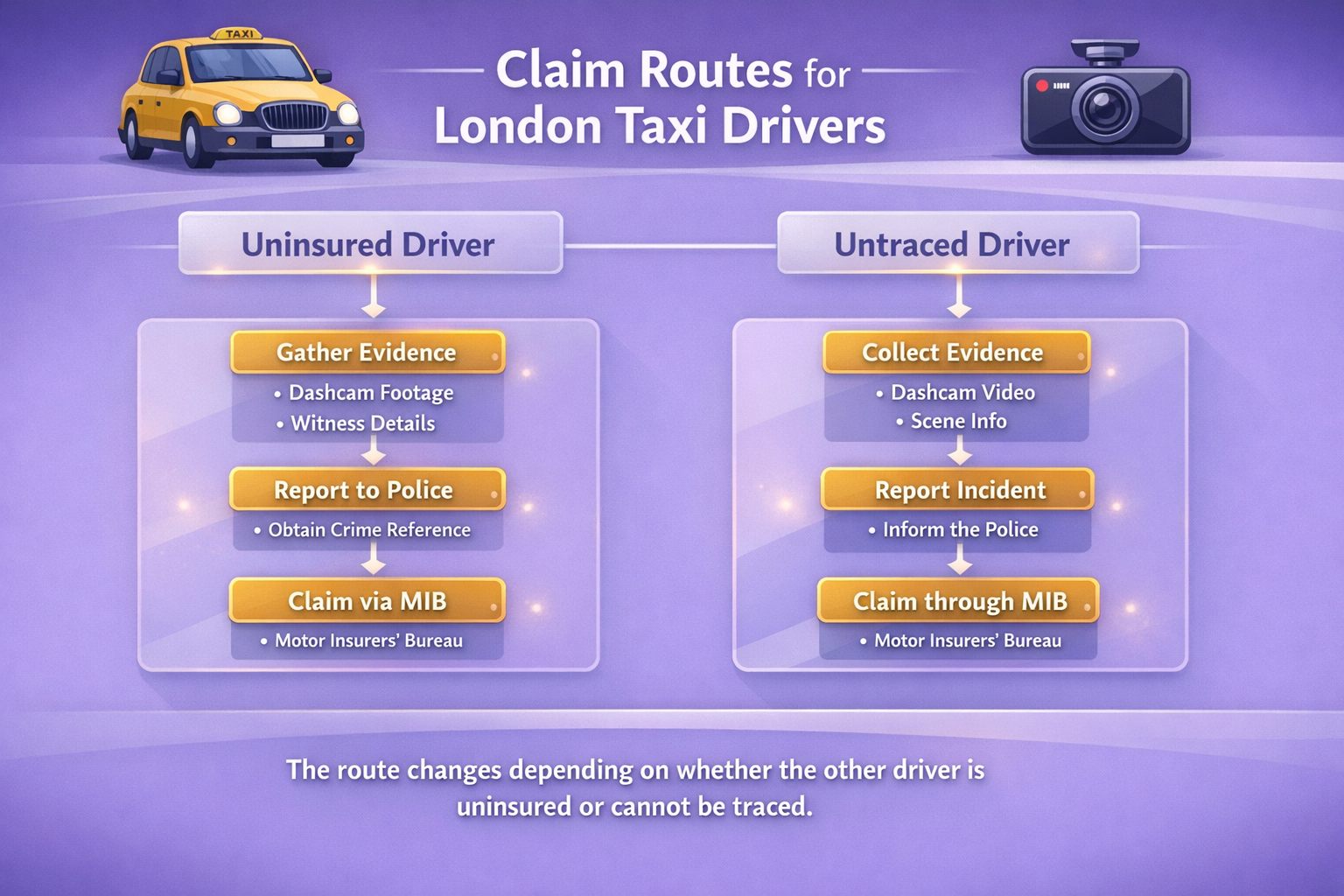
An uninsured driver is usually identified but not properly insured. An untraced driver is not reliably identified, which is why hit-and-run cases usually follow a different MIB route. Source: MIB.
This is where a lot of confusion starts. Some drafts used “hit and run,” “untraced,” and “uninsured” as if they were interchangeable. They are not. If the driver stops, gives details, and later turns out to have no valid policy, that is usually an uninsured-driver pathway. If the driver disappears and cannot be reliably identified, that is usually an untraced-driver pathway. MIB keeps them separate for a reason. Source: MIB.
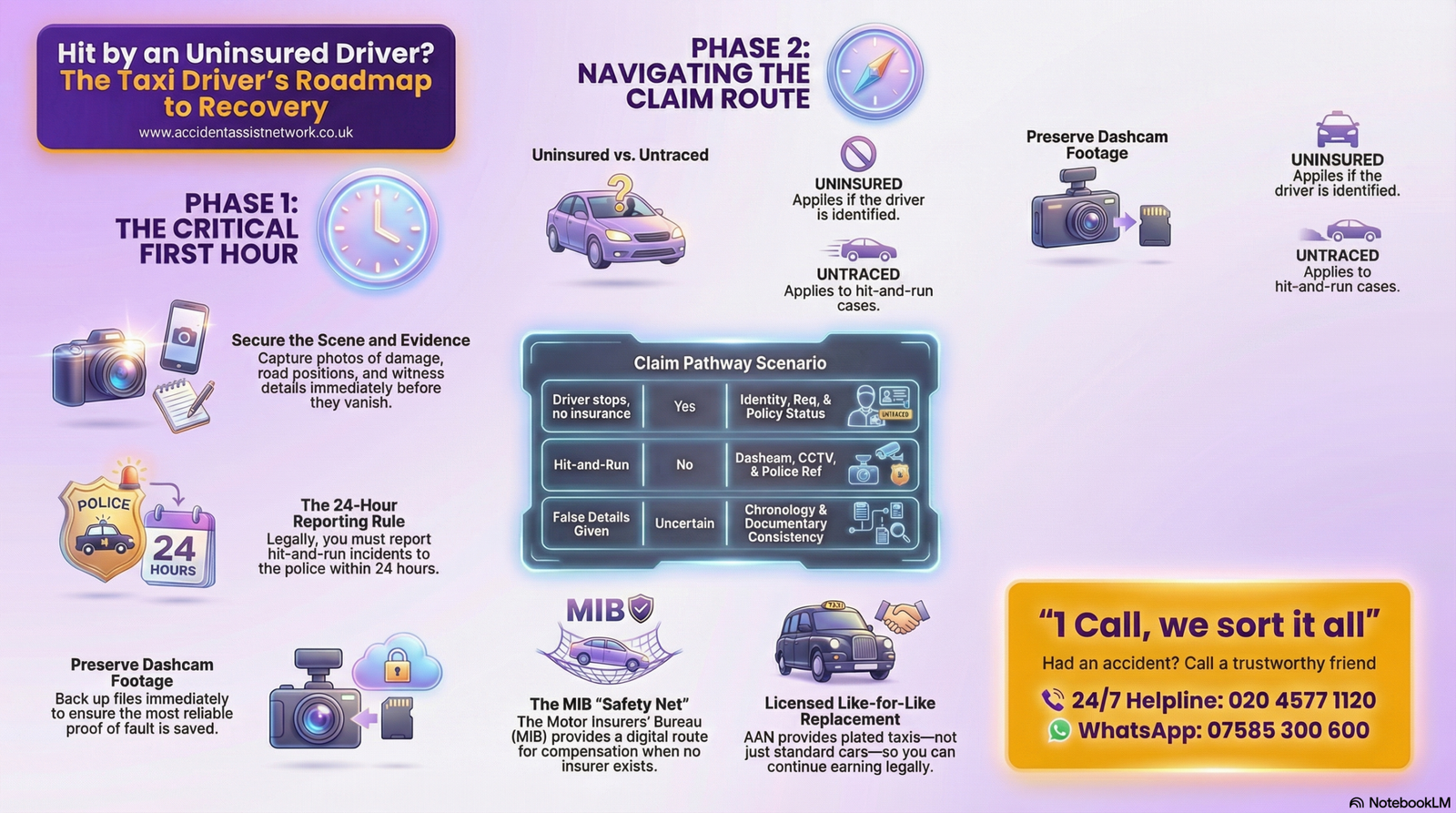
For a taxi driver, this changes the evidence strategy. If the driver is known, you focus on identity, registration, witness details, and policy status. If the driver disappears, you focus much more heavily on dashcam, CCTV possibility, witness details, scene photographs, and prompt reporting. The stress is the same, but the proof burden shifts.
Quick comparison
| Situation | Driver identified? | Likely route | Evidence priority |
|---|---|---|---|
| Driver stops, later found uninsured | Yes | MIB uninsured route | Identity, registration, witness details |
| Driver flees scene | No or uncertain | MIB untraced route | Dashcam, photos, witnesses, police reference |
| Driver details unclear or false | Uncertain | May need verification before route is clear | Full chronology and documentary consistency |
If you get the category wrong, the next steps can become muddled. That is why the first hour after the collision is so important.
Once you know which route you are likely in, the next issue becomes practical rather than legal: what should you do before the facts start fading?
What Should You Do First?
What should a taxi driver do in the first hour?
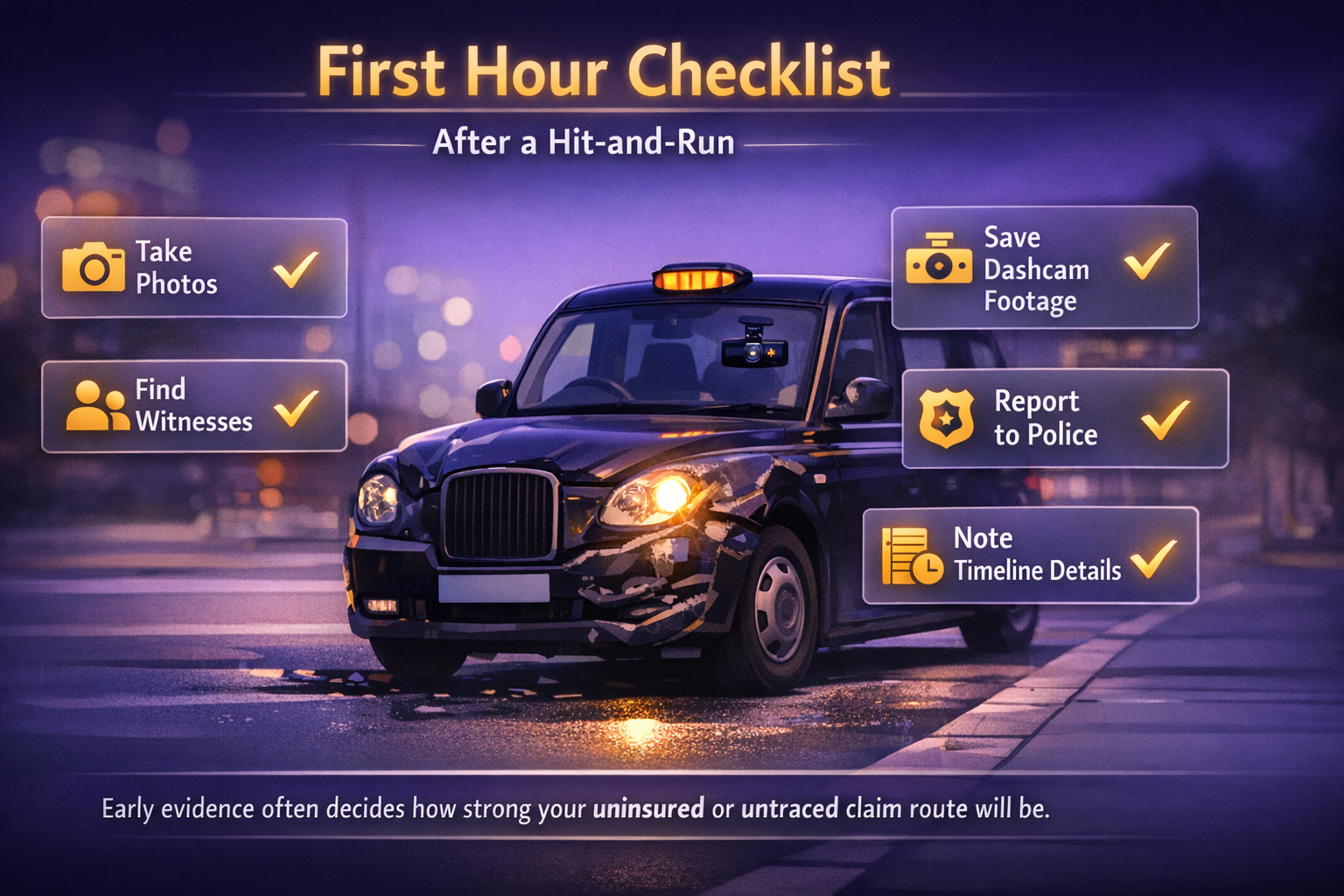
In the first hour, your job is to protect facts, not build a perfect claim. Focus on safety, photographs, witness details, registration if visible, and a clear time-ordered note of what happened. Source: legislation.gov.uk.
When a taxi or PHV is hit, the first instinct is often to jump straight to blame, cost, or replacement worries. That is understandable, but not useful yet. The safest route is to preserve what happened as cleanly as possible. Section 170 of the Road Traffic Act 1988 says that where required details are not exchanged, the accident must be reported as soon as reasonably practicable and in any case within 24 hours. That matters in hit-and-run and non-stop situations. Source: legislation.gov.uk.
The most reliable first-hour approach across the better drafts was not “say everything” but “record everything.” That means photographs from multiple angles, witness details, dashcam preservation, location, time, and immediate notes. For professional drivers, this stage is also commercial protection. Every missing detail can create delay later, and delay is what hurts your income most.
First-hour checklist
- Make sure you and any passengers are safe.
- Photograph damage, road position, and any identifying details.
- Preserve dashcam footage separately.
- Take witness names and contact details.
- Record the time, location, and what happened in order.
- Report appropriately where details were not exchanged.
Once your evidence trail is protected, the next question becomes much easier to answer: where does MIB fit, and what does the process look like in practice?
How Does MIB Fit Into The Process?
How do you start an MIB claim?
MIB's current claims service is paperless for direct claims under these agreements. You register online first, then submit the claim through the relevant route. Source: MIB.
One of the strongest practical points in the drafts was that older internet advice often sounds more paper-based than the current MIB route. MIB's current claim pages make clear that direct claimants register first and then submit claims online. That matters because it strips away one common misconception: that MIB is some vague fallback you deal with later by post. It is a live, defined route. Source: MIB.
That said, not every vehicle-damage loss sits neatly in one box. Some MIB guidance materials also explain that where a claimant has comprehensive cover for vehicle damage, there can be insurer-first logic for that part of the loss. That is exactly why overconfident source drafts were risky. They sometimes wrote as if every taxi driver should bypass every other route automatically. The safer position is to understand the claim route before committing to one assumption. Source: MIB guidance.
What MIB gives you
- A route where there is no normal insurer recovery path.
- Separate pathways for uninsured and untraced drivers.
- Online registration and claim handling.
- A formal framework, not just informal guidance.
What MIB does not remove
Strong Evidence
The need for strong evidence remains
Possible Delay
The possibility of delay in processing
Your Documentation
The need to keep your own documentation consistent
Off-Road Problem
The business problem of being off the road meanwhile
Because Asking is the first step
How does Accident Assist Network support London taxi drivers who need a licensed replacement cab after a non-fault accident?
That matters because being mobile is not the same as being able to keep earning legally.
Support for London taxi and PHV drivers after a non-fault accident → London Taxi
Ready to get your life back?
Call 020 4577 1120 now for immediate recovery and replacement-vehicle coordination. Or WhatsApp 07585 300 600 if that's easier. 0 upfront cost, deducted post-settlement.
The process only makes sense when you connect it to the real commercial problem professional drivers face, so the next section looks at why taxi and PHV cases feel different from ordinary private-motorist claims.
Why Taxi Drivers Feel The Pressure More
Why is downtime harder for taxi and PHV drivers?
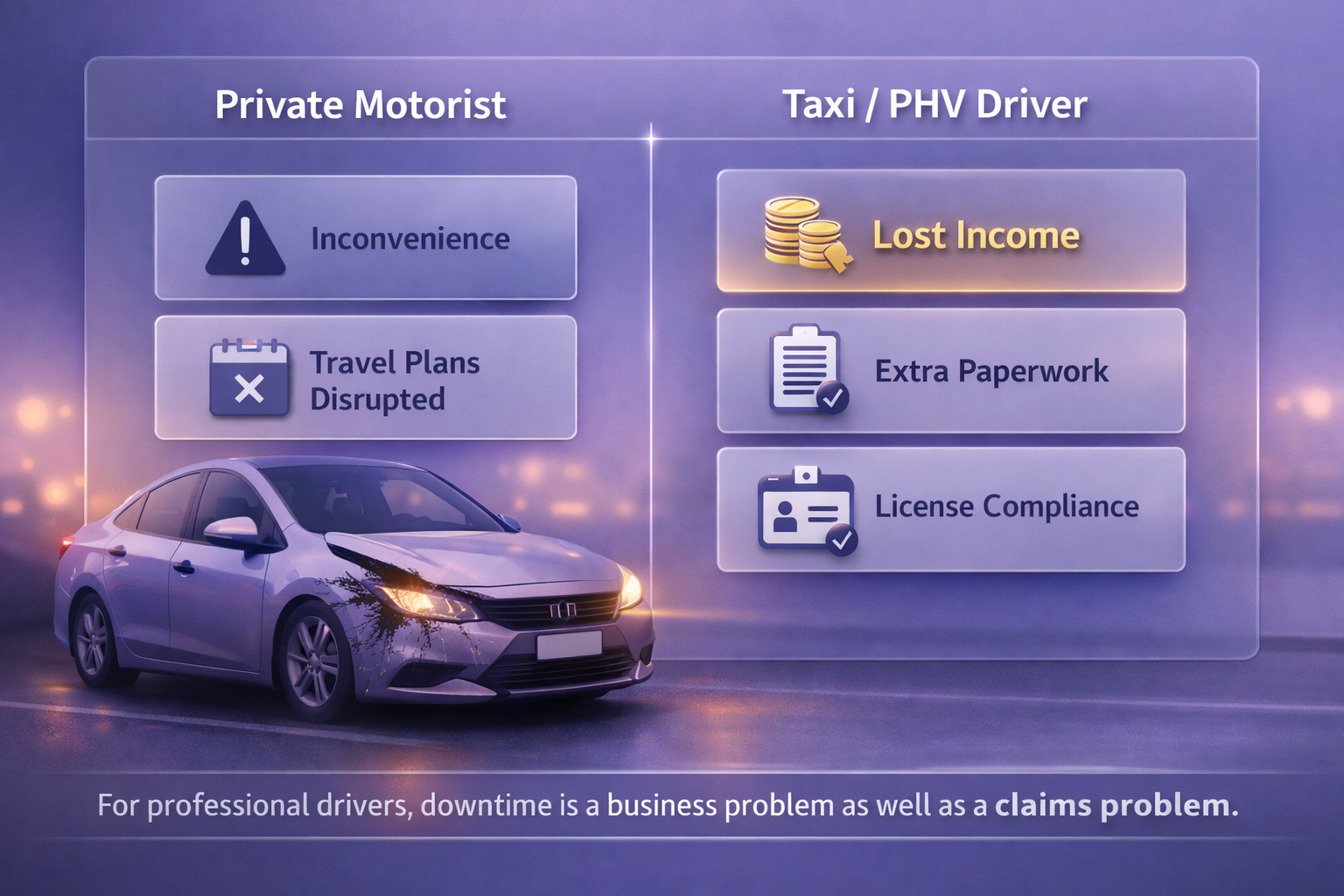
For a private motorist, downtime is inconvenience. For a taxi or PHV driver, it can become immediate interrupted income, booking disruption, and licensing pressure. TfL also requires hire-or-reward insurance at licensing and renewal for PHVs. Source: TfL.
This is where the best source drafts were right to narrow the reader profile. An uninsured-driver guide for a private motorist and one for a London taxi driver should not sound the same. Taxi and PHV drivers are dealing with roadworthiness, shift continuity, earnings protection, and insurance/licensing compliance all at once. TfL states that if you are a new applicant or renewing a PHV licence, the vehicle must be covered by hire-or-reward insurance at the point of licensing. That shows why professional drivers are so sensitive to documentation and continuity. Source: TfL.
The emotional problem is also different. You are not just asking, “How do I repair my vehicle?” You are asking, “How do I stop this collision from swallowing a week of work?” That is the point where practical coordination can matter, provided it is described honestly.
Taxi-driver realities this guide is built around
- You may need a suitable plated or work-appropriate vehicle, not just any hire car.
- Gaps in paperwork can affect more than the claim narrative.
- Delay is often more damaging than the headline repair issue.
- Calm sequencing beats reactive decisions.
Once you frame the issue properly, the next step is avoiding the mistakes that make an already difficult route even harder.
What Mistakes Usually Weaken The Case?
Which mistakes cause the biggest problems?
Most bad outcomes start with small gaps rather than dramatic errors: missing witness details, vague timelines, weak scene evidence, or delayed reporting in non-stop cases.
Across the uploaded drafts, the strongest common insight was that poor evidence discipline hurts more than loud panic does. Drivers often assume the hard part is proving the other driver did wrong. In practice, the hard part is often proving what happened cleanly enough that the route does not get bogged down.
Some drafts also overpromised on speed, vehicle availability, and insurance consequences. That can be as damaging as weak evidence because it pushes the reader toward certainty where there is still variation. The better standard is this: state what you know, record what you can prove, and be careful with what you assume.
Common mistakes to avoid
- Waiting too long to write down the sequence of events.
- Assuming dashcam footage is safe without backing it up.
- Treating witness details as optional.
- Blurring “uninsured” and “untraced” in your own account.
- Thinking no insurer means no route at all.
- Jumping into commitments before understanding the claim pathway.
Because Asking is the first step
I'm a London taxi driver and the other driver had no insurance — can I still get help understanding my next steps?
That can help you make calmer decisions while your taxi is off the road.
Non-fault support for car and van drivers / taxi drivers → Car & Van Drivers or London Taxi
Got questions about uninsured driver claims?
We're here to help. Call 020 4577 1120 or WhatsApp 07585 300 600 for friendly, no-obligation guidance.
What Should You Do Next?
When is guided support actually useful?
Guided support is most useful when the vehicle is off the road, the route feels unclear, or you need practical help with recovery, repairs, and replacement options while the wider claim process develops.
Accident Assist Network's role needs to be stated carefully. It is not a solicitor, not a personal injury service, and not a financial adviser. It is a vehicle-damage coordination service for non-fault accidents, helping drivers understand and arrange practical next steps through a network of independent specialist companies. That limit matters because it keeps the support honest and compliant with the service scope set in your AAN materials.
For some drivers, the main need is simply clarity: what happened, what route am I in, and what should I preserve right now? For others, the issue is operational: how do I think about recovery, storage, and replacement-vehicle options without making a rushed decision that creates a bigger problem later? That is where calm, limited, practical help can add value.
💭 Interactive reflection prompt
If the other driver disappeared tonight, could you put your hand on these five things within ten minutes: your photos, witness details, dashcam file, police reference, and a simple written timeline?
If the answer is no, that is not a failure. It is a useful warning sign that your process needs tightening before the next incident, not after it.
🎯 Your Next 3 Moves
Immediate: Save every photo, witness contact, and reference number in one place.
This session: Write a clean, time-ordered account while it is still fresh.
This week: Review your recovery, repair, and replacement-vehicle options if your taxi is off the road.
Sources & References
- Source: GOV.UK — compensation for victims of uninsured or hit-and-run drivers. (GOV.UK)
- Source: MIB — claiming against an uninsured driver. (MIB)
- Source: MIB — claiming against an untraced driver. (MIB)
- Source: legislation.gov.uk — Road Traffic Act 1988, section 170. (legislation.gov.uk)
- Source: TfL — private hire insurance requirements at licensing and renewal. (TfL)
Accident Assist Network assists you after a non-fault accident by co-ordinating vehicle recovery, reputable repairs, cash-in-lieu settlements for total-loss vehicles, and like-for-like replacement hire—whether for personal use, licensed taxi work or bike—through our network of independent specialist companies across England. Your one call and we sort it all.
Because our role is one of practical facilitation rather than financial advice, we are not authorised by the Financial Conduct Authority, and our services are not covered by the Financial Ombudsman Service or the Financial Services Compensation Scheme.
Our partner companies will always endeavour to help you recover costs from the at-fault insurer; however, if that insurer delays or disputes payment you may become liable for credit services or other charges set out in your contract. Each partner company will supply its own terms and conditions in agreements. Please read every document thoroughly and, if anything is unclear, ask us—or an independent adviser—before signing. We are happy to guide you in the language you feel most comfortable with.
Need practical help in England? Call 020 4577 1120 | WhatsApp 07585 300 600
Frequently Asked Questions
Can you still claim if the other driver fled the scene?
Do you have to report a hit-and-run to the police?
Does MIB treat uninsured and untraced drivers the same way?
Can a taxi driver rely on any courtesy car while waiting?
Will this automatically affect your no-claims bonus?
Can Accident Assist Network handle personal injury claims?
Because Asking is the first step
What happens if the other driver's insurer disputes fault — will I end up with a bill from Accident Assist Network?
Clear explanation early helps you make better decisions later.
How non-fault claim pathways and service scope work → Non-Fault Accident Claims
Call a trustworthy friend: 020 4577 1120
We're here 24/7 to walk you through every step. WhatsApp 07585 300 600 for immediate support.
Raheel A Rathore
Director, Accident Assist Network | 15+ years helping drivers across England understand non-fault vehicle-damage options clearly