

31-min read
Non-fault driver reviewing credit hire paperwork beside a replacement vehicle in the UK
Credit Hire UK Explained – Vehicle Agreement Guide 2026
Credit hire UK explained for non-fault drivers: understand replacement vehicle agreements, charges and risks. Call 020 4577 1120 for clear guidance.

If you were not at fault in a car accident, UK law entitles you to a free like-for-like replacement vehicle, fully managed claim, and zero out-of-pocket costs — but only if you act through the right channel.
When an accident happens, the physical impact is often followed immediately by a wave of administrative panic. You are left staring at a dented bumper, wondering how you will get to work tomorrow. Instead of seeking immediate help, many drivers freeze — because the UK motor claims system is notoriously difficult to navigate without a guide.
Credit Hire UK Explained – Vehicle Agreement Guide 2026
Writer Introduction
I’m Raheel A Rathore, Director of Accident Assist Network, sharing 15+ years of England motor claims coordination experience on credit hire.
Quick Answer Box
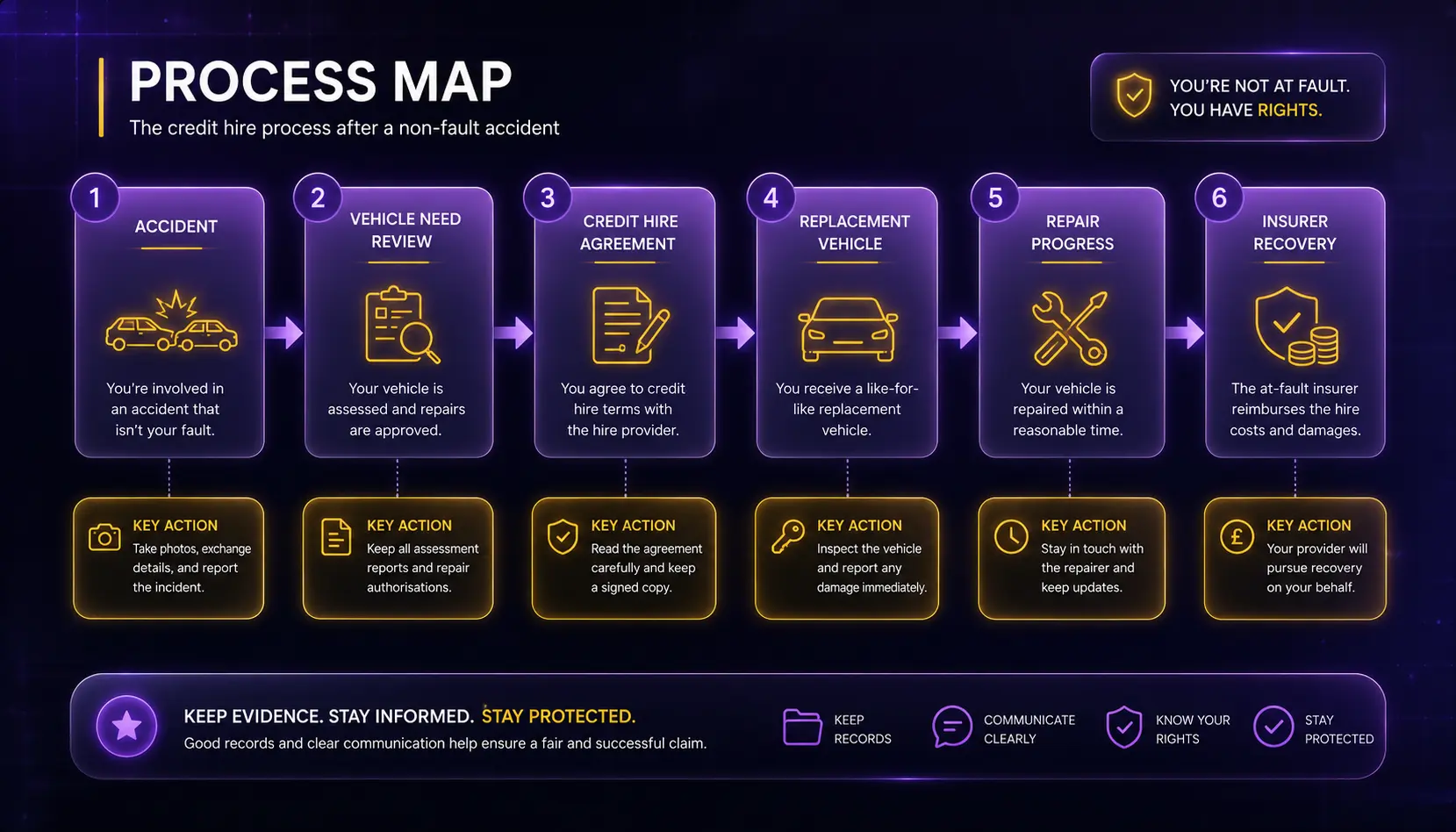
Credit hire is a replacement vehicle arranged on credit after a non-fault accident while your damaged vehicle is repaired or assessed.
- The hire cost is usually pursued from the at-fault insurer, not paid upfront by you.
- You sign a credit hire agreement, so the daily rate and responsibilities matter.
- A like-for-like replacement vehicle must match a genuine, reasonable need.
- Hire charges can still be challenged if need, rate, duration, or liability is disputed.
- Keep evidence from day one before stress turns into paperwork confusion.
Before accepting a vehicle, understand what you are signing, who may pay, and what you may need to prove later.
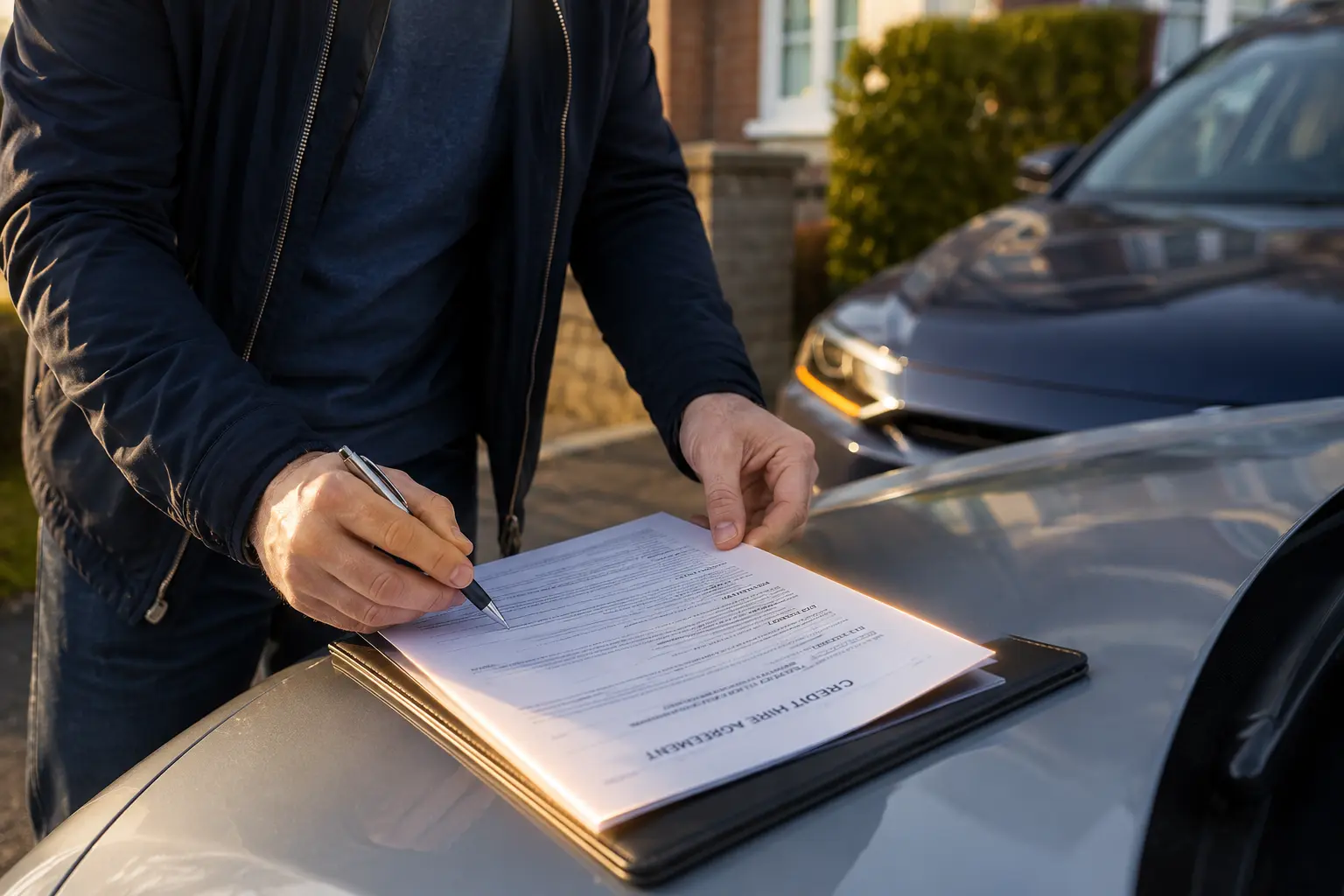
You may have been told, “It was not your fault, so you can have a replacement car.” That sounds reassuring until someone places a credit hire agreement in front of you. You might be wondering who pays, whether the at-fault insurer can argue later, and whether you could be left with charges. This guide explains credit hire UK in plain English for family drivers, work-vehicle drivers, taxi/PHV drivers, and cautious signers. Keep reading before you treat a hire car offer as a simple yes-or-no decision.
CTA #1
Had an accident and unsure what to sign? Call 020 4577 1120 or WhatsApp 07585 300 600 for calm, 24/7 vehicle-damage coordination guidance in English, Romanian, Urdu, Tamil, or Hindi.
What Is Credit Hire?
What does credit hire mean after an accident?
Credit hire means a temporary replacement vehicle is supplied on credit after a non-fault accident. You normally do not pay the hire charge upfront. The credit hire provider later seeks recovery from the at-fault insurer, but the agreement and your responsibilities still matter.
The Financial Ombudsman Service explains that after a non-fault incident, one option is a non-fault service where an accident management company may handle repairs and/or arrange a hire car under a credit hire or repair agreement. The same guidance says the consumer may receive a hire vehicle, normally a like-for-like or similar replacement, and may enter into an unregulated agreement setting out daily hire charges. Source: Financial Ombudsman Service. (Financial Ombudsman)
Citizens Advice gives a similar England-focused explanation: if the accident was not your fault, a credit hire company can pay for replacement vehicle hire while yours is fixed and then claim those costs from the other driver’s insurer. Source: Citizens Advice. (Citizens Advice)
Term
Plain-English Meaning
Credit hire
A replacement vehicle supplied on credit after a non-fault accident
Credit hire agreement
The paperwork setting out hire charges and responsibilities
At-fault insurer
The insurer asked to pay the hire and repair costs
Hire charges
Daily vehicle hire costs pursued after the hire period
Replacement vehicle
The temporary vehicle you use while yours is repaired or assessed
Bridge: Once the meaning is clear, the next question is whether the other side pays everything without challenge.
Who Pays Hire Charges?
Can the at-fault insurer challenge costs?
The hire charges are usually pursued from the at-fault insurer, but payment is not automatic. Even when fault looks clear, the insurer may challenge the vehicle need, daily hire rate, hire period, paperwork, or the amount being claimed.
This is where many drivers get caught out. “The accident was not my fault” and “every hire charge will be accepted” are not the same thing. The Financial Ombudsman Service says that if the third-party insurer disputes liability or the amount of credit costs, the consumer may need to cooperate with recovery or may become liable for those costs. Source: Financial Ombudsman Service. (Financial Ombudsman)
Citizens Advice also tells drivers to check the small print before signing. It says the agreement should include the cost per day and may explain what you must pay if you do not cooperate or mislead the company. It also notes you may need to prove you needed the hire car and could not pay for it without credit hire support. Source: Citizens Advice. (Citizens Advice)
What May Be Accepted | What May Still Be Questioned |
|---|---|
The other driver caused the collision | Whether you genuinely needed a vehicle |
Your vehicle needed repair or assessment | Whether the daily hire rate was reasonable |
You needed mobility
Whether the hire lasted too long
A replacement was supplied
Whether the vehicle type matched your need
Bridge: To make a good decision, compare credit hire with the option many drivers already know: the courtesy car.
Credit Hire vs Courtesy Car
Is a courtesy car the same route?
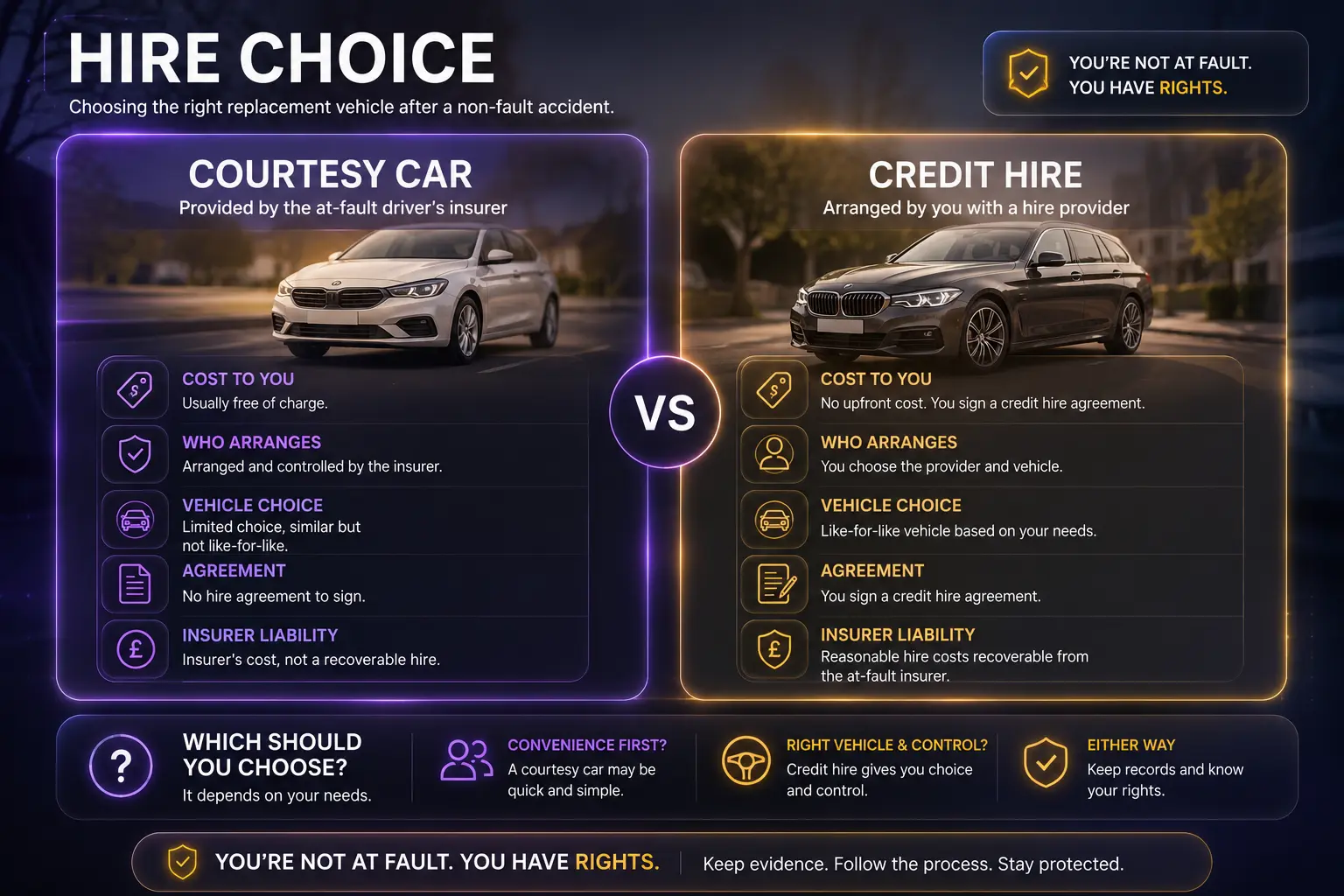
A courtesy car is usually linked to your own insurance policy or repairer. Credit hire is arranged on credit after a non-fault accident and the hire charges are pursued from the at-fault insurer. The better route depends on your policy, vehicle need, and paperwork risk.
A courtesy car can be simple if your own policy includes one and the repair route is clear. But the vehicle may be basic, limited by policy wording, or unavailable in the size you need. Credit hire may offer a more suitable like-for-like replacement vehicle, but the agreement and cost recovery process are more involved.
AX defines credit hire as a temporary replacement vehicle provided by a Credit Hire Organisation after a non-fault road traffic accident, with the organisation funding hire while the damaged vehicle is repaired and claiming the hire charges back from the at-fault party’s insurer. Source: AX. (Ax UK)
Question | Courtesy Car |
|---|
Credit Hire
Who arranges it?
Your insurer or repairer
Credit hire / accident management route
Is it always like-for-like?
Not always
Usually based on reasonable vehicle need
Do you sign extra paperwork?
Usually simpler
Usually yes
Can charges be challenged later?
Less direct for you
Yes, hire charges may be disputed
Best fit
Simple policy-based mobility
Clear non-fault need with suitable paperwork
Bridge: The vehicle choice should start with your real-life need, not just what sounds convenient.
Family Drivers Need Fit
Why does vehicle size matter for families?
Family drivers often need a replacement vehicle that fits school runs, child seats, shopping, commuting, and caring responsibilities. Credit hire may be suitable where the damaged car is off the road and the replacement vehicle matches a genuine daily need.
Imagine a parent whose seven-seat family car is unsafe after a rear-end collision. A small courtesy car may not work if there are child seats, pushchairs, or regular caring duties. In that situation, the issue is not comfort. It is whether the replacement vehicle is reasonably needed for daily life.
But the opposite can also be true. If the damaged vehicle is still safe and roadworthy, or you already have access to another suitable car, the need for credit hire may be harder to justify. The Financial Ombudsman Service says a referral may be unsuitable if it was clear the consumer did not need a hire car, such as having a suitable spare car or already having sufficient courtesy car cover. Source: Financial Ombudsman Service. (Financial Ombudsman)

Quick poll — what is your biggest concern after a non-fault accident?
Accident Assist Network assists you after a non-fault accident by co-ordinating vehicle recovery, reputable repairs, cash-in-lieu settlements for total-loss vehicles, and like-for-like replacement hire — whether for personal use, licensed taxi work or bike — through our network of independent specialist companies across England. Your one call and we sort it all. Because our role is one of practical facilitation rather than financial advice, we are not authorised by the Financial Conduct Authority, and our services are not covered by the Financial Ombudsman Service or the Financial Services Compensation Scheme.