Crash for Cash Tactics London Taxi Drivers Must Spot in 2026
Crash for cash scams can target London taxi drivers with staged collisions, fake injuries and document theft. Spot the warning signs. Call 020 4577 1120.

🔍 QUICK ANSWER
Crash for cash is a form of insurance fraud where criminals stage, induce, or even invent collisions so they can make a dishonest claim. ABI and UK police guidance still treat it as a live risk, and current City of London Police advice includes moped-linked scams and document-photo misuse. Source: ABI and Source: Ask the Police and Source: City of London Police
- London taxi and PHV drivers can feel especially exposed because they spend long hours in dense, low-speed traffic where blame can be muddied quickly.
- Common scam patterns include sudden brake traps, being waved into danger, fake witnesses, and pressure to let someone photograph your documents.
- Your safest first moves are to stay calm, avoid admitting liability, preserve footage, record the scene, and report concerns promptly.
- Front and rear dashcams can help deter fraud and strengthen your evidence position. Source: ABI dash cams guidance
- If you drive for a living, this is not just about avoiding one bad claim. It is about protecting your income, your evidence, and your next shift.
Suspicious non-fault collision damaged your vehicle?
Call 020 4577 1120 or WhatsApp 07585 300 600 for calm, practical guidance on the vehicle-damage side. Accident Assist Network works on 0 upfront cost, deducted post-settlement.
🎬 Watch video guide about crash for cash tactics for London taxi drivers
Watch the video guide for a clear overview of crash for cash tactics, how to spot them, and what London taxi drivers should do to protect themselves.
Because Asking is the first step
What does Accident Assist Network do and how can it help me right now?
That gives you a clearer route when your main concern is protecting your position and getting back to work.
Learn how Accident Assist Network supports drivers across England
You know how fast a normal shift can turn awkward in London traffic. One sudden brake, one driver insisting you were reckless, one suspicious request for your documents, and suddenly you are not thinking about fares anymore. You are thinking about footage, witnesses, insurer arguments, and how many hours you could lose if your cab is off the road. That pressure is real. If you drive for a living, generic motoring advice is not enough. You need to know what crash for cash looks like from behind the wheel, what signs matter most, and what to do in the first few minutes if something feels engineered. This guide gives you that practical playbook.
What Is Crash For Cash?
How do UK authorities define crash for cash?
Crash for cash is a form of insurance fraud in which criminals deliberately stage, induce, or invent a collision so they can submit false or exaggerated claims. Ask the Police breaks the scam into staged accidents, ghost accidents, and induced accidents. Source: ABI and Source: Ask the Police
For taxi drivers, that definition matters because the risk is wider than vehicle damage. A staged collision can quickly turn into a messy liability argument, a false injury narrative, or a dispute over who caused what. The fraud itself may be low-speed. The consequences for you often are not.
ABI describes these scams as deliberate incidents used to profit from insurance claims. Police guidance adds that some are fully staged, some are induced by tricking an innocent driver into contact, and some are ghost claims where a crash is reported even though it never happened. That means you do not need a dramatic motorway pile-up to become part of the scam. A slow-moving junction, queue, rank exit, or tight urban merge can be enough.
| Scam Type | What It Means | Why It Matters To You |
|---|---|---|
| Staged accident | A collision is deliberately set up | You may be pulled into a planned claim |
| Induced accident | You are tricked into making contact | It may look like obvious blame at first |
| Ghost accident | A claim is made for an incident that never happened | Your details may be misused later |
Crash for cash is not one trick. It is a pattern of behaviour built around pressure, confusion, and weak evidence. That makes the next question the one professional drivers care about most.
Why Are London Taxi Drivers Attractive Targets?
Why would scammers pick taxi or PHV drivers?
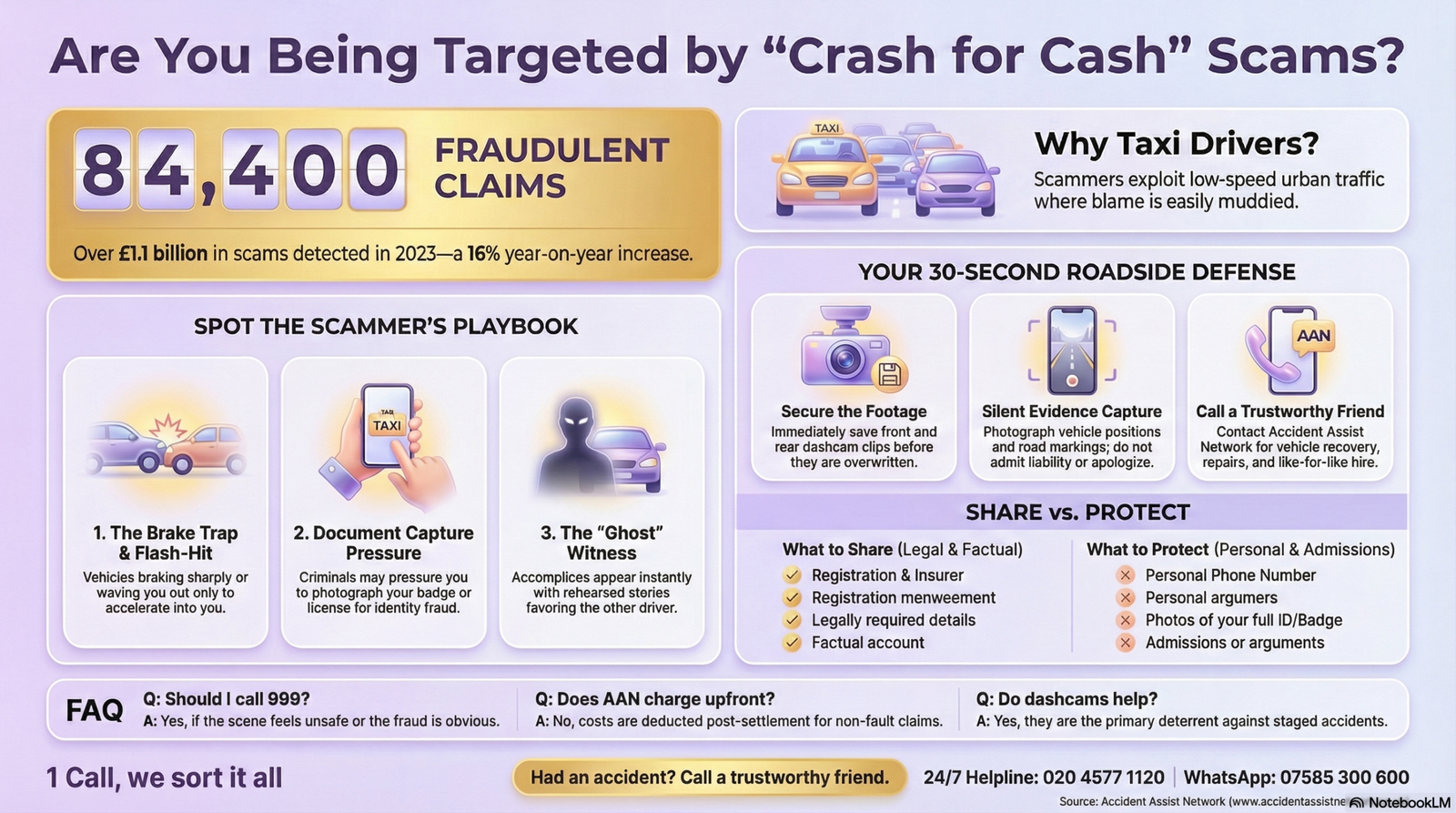
Taxi and PHV drivers can feel especially exposed because they work long hours in dense, low-speed traffic where sudden stops, junction pressure, and frequent interaction with strangers make engineered incidents easier to disguise. That is a practical risk pattern, not a criticism of professional drivers.
A fraudster does not need to prove you are careless. They only need enough confusion to let a false or exaggerated story breathe. City driving gives them the setting: stop-start traffic, busy ranks, airport runs, narrow side roads, and constant pressure to keep moving.
That is why this topic lands differently for a professional driver than for a private motorist. When your vehicle is off the road, you are not just dealing with inconvenience. You may be thinking about lost work, cancelled bookings, paperwork, and how long it will take before someone believes your version of events.
Current UK guidance still treats crash for cash as significant. A 2024 government anti-fraud announcement described crash for cash scams as a growing issue and said 84,400 fraudulent claims worth £1.1 billion were detected in 2023, with a 16% increase in detected claims versus the previous year. Source: GOV.UK
Taxi-driver risk factors
- You spend more time in the exact traffic conditions scammers prefer.
- Low-speed contact can still trigger large allegations later.
- You may have passengers, which adds pressure and distraction.
- You cannot afford vague evidence if blame is disputed.
- Time off the road hurts quickly when driving is your income.
Imagine being waved across a lane near a station pickup, then clipped by a car that seemed to appear from nowhere. In the moment, it feels chaotic. Later, it may feel choreographed. That is why you need to know the playbook before you need to describe it.
What Scam Tactics Should You Watch For?
What does an induced or staged collision look like?
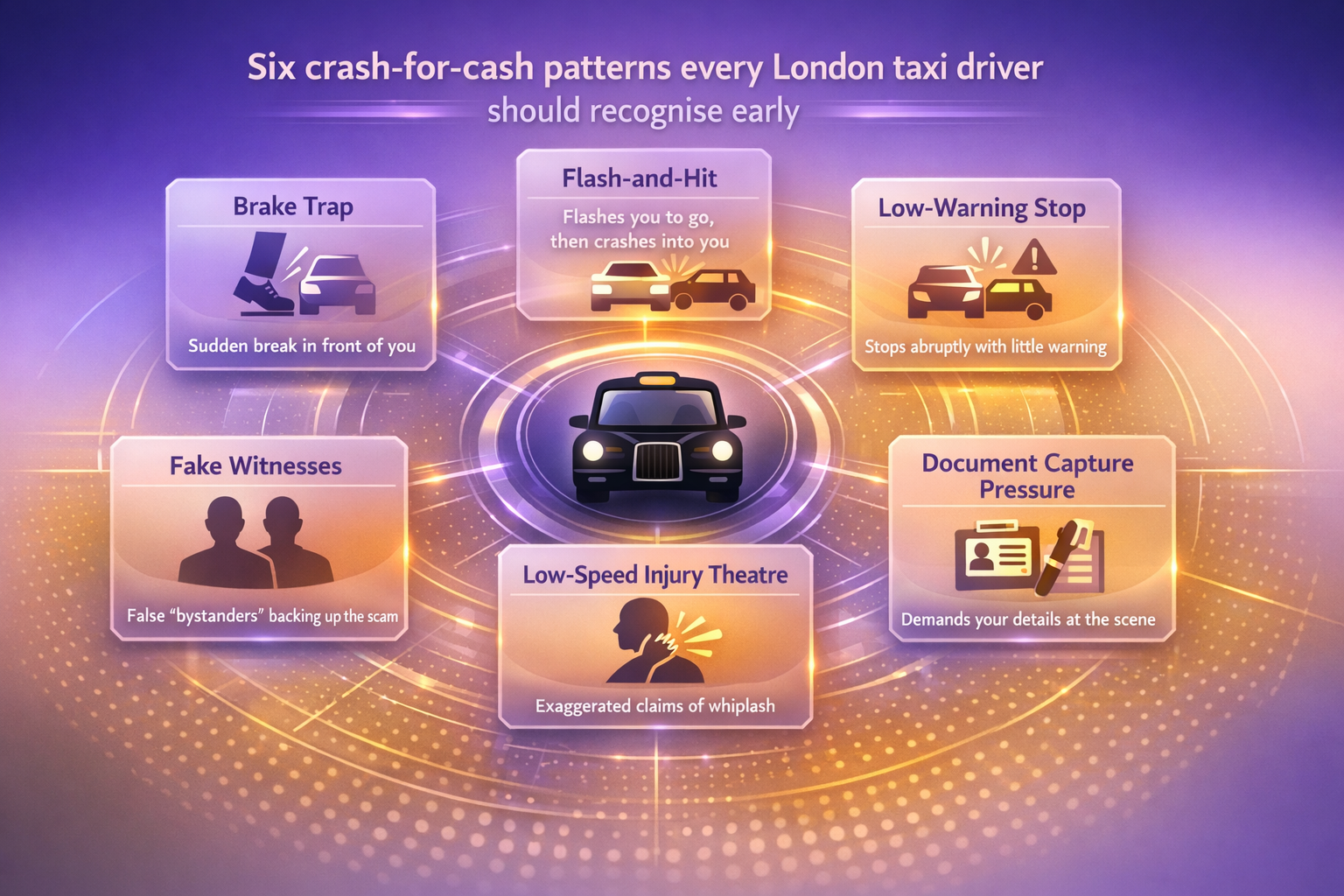
Common crash for cash tactics include sudden braking, engineered right-of-way traps, fake witnesses, exaggerated injury behaviour, and pressure to photograph documents after the collision. Current City of London Police guidance also warns about moped-linked versions and document misuse. Source: ABI and Source: City of London Police
The strongest source drafts agreed on one thing: the best blog needs a clear tactical list, not vague warnings. Here are the six patterns most worth recognising as a London taxi or PHV driver.
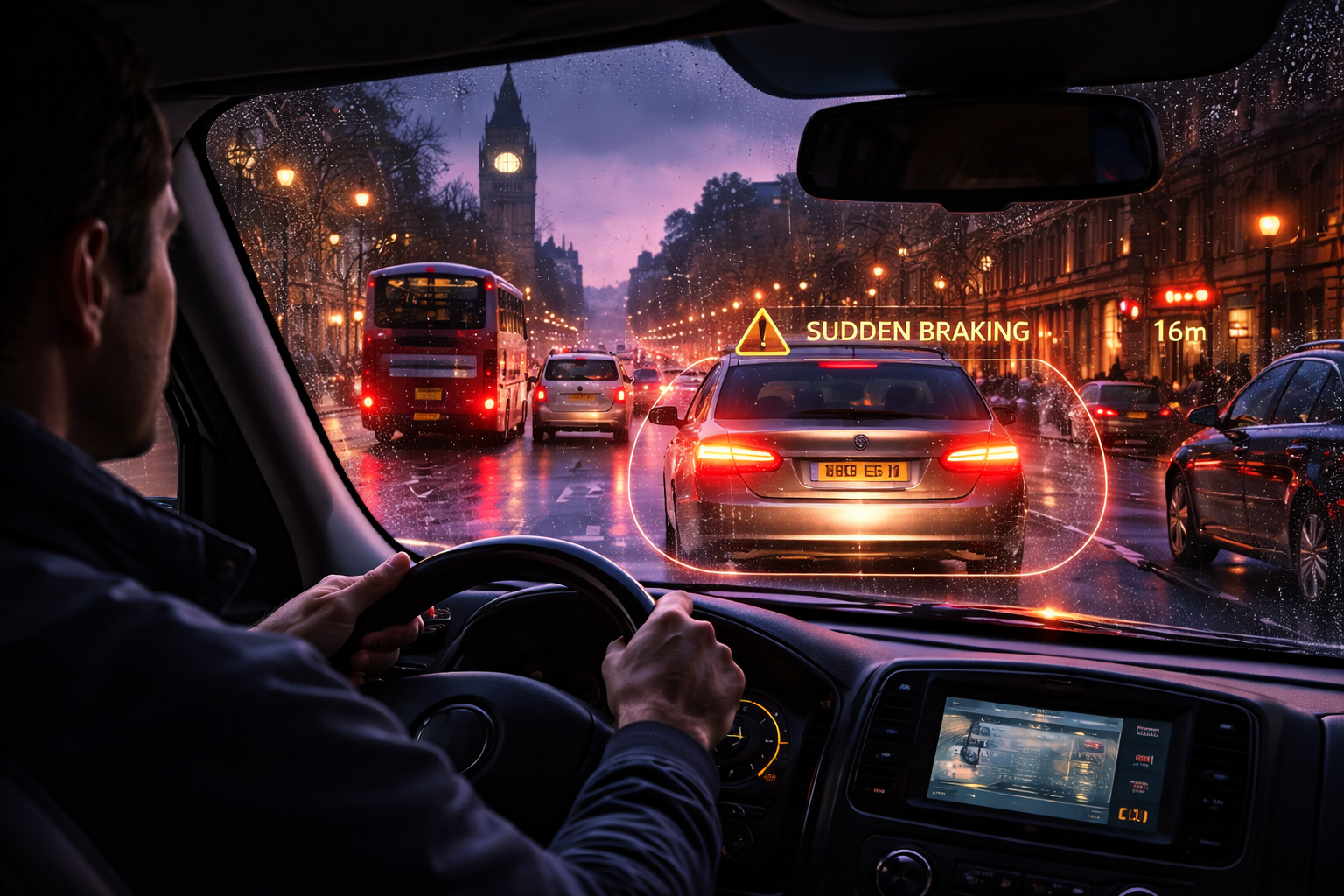
Brake Trap
The vehicle ahead brakes sharply for no good reason, often when you have limited room to react.
Flash-and-Hit
Someone appears to wave you out or give way, then the collision happens as soon as you commit.
Brake-Light Trick
You get less reaction time than you would normally expect from a low-warning stop.
Fake Witness Support
People appear too quickly with a polished story that favours the other side.
Low-Speed Injury Theatre
Instant claims of severe pain after a minor impact.
Document Capture Pressure
Strong insistence on photographing your licence, badge, or insurance certificate.
City of London Police warns that fraudsters may pressure you to show your driving licence and insurance certificate after a collision, then photograph them. In some cases, that information has allegedly been used to take out fraudulent insurance policies. Source: City of London Police
Roadside red flags
- The other side seems rehearsed, not shaken.
- The story is too ready, too fast.
- You are pushed to admit blame immediately.
- The focus is on your documents, not the collision.
- Bystanders appear unusually eager to help one side.
Many drivers focus only on the impact itself. The smarter move is to study what happened before it and what starts happening seconds after it. That is where the strongest warning signs usually live.
What Should You Do If Something Feels Wrong?
What are the safest first steps after a suspected scam?
If you suspect crash for cash, your first priority is safety and evidence preservation. Stop safely, check for injuries, avoid admitting liability, record the scene, and contact police if the situation is unsafe or the fraud concern is serious. Source: Ask the Police and Source: ABI accident guidance
You do not need to “win” the argument at the roadside. You need to leave with your position protected. That means fewer speeches and better evidence.
The biggest mistake is often emotional. If something feels staged, your instinct may be to confront the other driver. That can raise risk, reduce your control, and distract you from the details that matter most later. A better approach is quiet, disciplined evidence capture.
Taxi Driver Roadside Evidence Checklist
- Stop safely and check whether anyone is injured.
- Keep your interaction factual and calm.
- Do not admit liability or apologise for causing the collision.
- Save and protect dashcam footage immediately if possible.
- Take wide and close-up photos of positions, damage, road markings, and signs.
- Record names, registration numbers, and witness details.
- Note anything unusual: being waved out, sudden braking, witness behaviour, document pressure.
- Contact emergency services if anyone is injured, the road is blocked, or the scene feels unsafe.
- Notify your insurer promptly and stick to facts.
What to share vs what to protect
| Share | Protect |
|---|---|
| Basic legally required exchange details | Extra casual document photos |
| Registration and insurer details as required | Unnecessary images of your full documents |
| Factual account of what happened | Speculation, admissions, or roadside arguments |
That evidence routine matters because the next question is not just what happened. It is what proof will still matter when stories start moving around.
What Evidence Protects You Best?
Which proof matters most in a disputed claim?
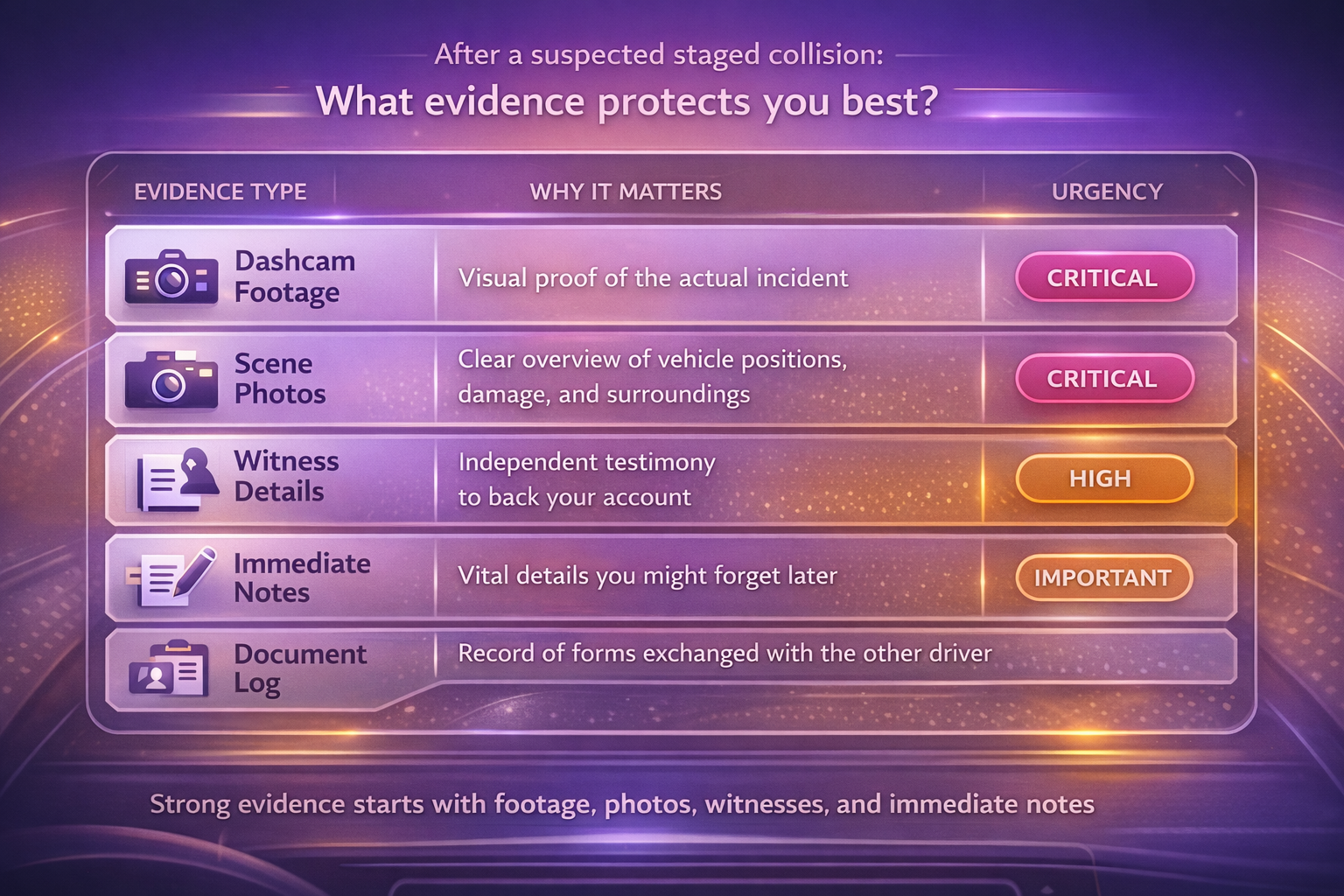
The most useful protection usually comes from layered evidence: dashcam footage, time-stamped photos, independent witnesses, and clear notes made immediately. ABI says dashcams may help deter fraud and provide extra peace of mind in crash-for-cash claims. Source: ABI dash cams
For taxi drivers, evidence has to do two jobs at once. It has to help defend liability and help explain the working context you were in. A still image of bumper damage rarely tells the full story. A short note that says “vehicle waved me out, then accelerated” may matter far more than a general memory written the next day.
Evidence priority order
- Front and rear dashcam footage — shows the behaviour before impact
- Scene photos — preserves positions, markings, and vehicle damage
- Independent witnesses — helps when the story changes
- Immediate notes — protects detail before memory fades
- Document log — records what was shared and when
A simple working rule: if it is unusual, write it down. If it can disappear, photograph it. If it is on camera, back it up.
Strong evidence helps after the event, but smart prevention habits reduce the chance of being trapped in the first place.
How Can You Lower The Risk Every Shift?
What prevention habits actually help?
You cannot control fraudsters, but you can make yourself harder to exploit. Dashcams, distance discipline, careful document handling, and a calm reporting routine all improve your position if something suspicious happens.
The best prevention habits are not dramatic. They are repeatable. Keep more distance than feels comfortable in slow traffic. Be cautious around sudden courtesy gestures. Assume low-speed contact can still become a major dispute. Protect your footage and your documents like part of your livelihood, because they are.
Shift-start protection routine
- Check your front and rear dashcams are recording.
- Make sure the time stamp is correct.
- Keep the windscreen and camera view clean.
- Know how to save footage quickly.
- Keep a one-minute note template ready on your phone.
- Stay cautious near merges, ranks, roundabouts, and airport pickup zones.
What helps vs what catches drivers out
| What Helps | What Catches Drivers Out |
|---|---|
| Better camera coverage | Overwritten footage |
| More distance | False confidence |
| Calm reporting | Roadside arguments |
| Controlled document sharing | Oversharing personal details |
💭 Reflection Prompt
Imagine you are waved out at a crowded London junction, then hit seconds later by a vehicle that claims you pulled out recklessly.
What would you secure first: your footage, your witness details, or your note of what happened before impact?
If your answer is not “all three, in that order of risk,” it is worth rehearsing your response before your next shift.
Prevention is important, but you also need to know where support becomes relevant after a suspicious non-fault accident damages your vehicle.
Where Should You Report It And What Help Is Relevant?
Who should you contact after a suspected crash for cash incident?
Your route may include police, your insurer, and practical vehicle-damage support where relevant. The key is fast, factual reporting without guessing or exaggerating. Source: Ask the Police and Source: ABI accident guidance
If your taxi is damaged in a suspected non-fault incident, practical support then becomes part of the picture. That is where Accident Assist Network may be relevant. Its role is not personal injury, criminal investigation, or financial advice. Its role is vehicle damage only: helping coordinate recovery, repairs, cash-in-lieu where relevant, and like-for-like replacement support through its specialist network across England.
Simple reporting path
- Deal with immediate safety.
- Preserve evidence.
- Notify your insurer promptly.
- Contact police if there is injury, danger, or strong fraud concern.
- If the vehicle is damaged and the case is genuinely non-fault, explore practical support for the vehicle side.
🎯 Your Next 3 Moves
Immediate: Check your dashcam setup and save procedure today.
This shift: Build a one-minute note template for suspicious incidents.
This week: Save the support number you would want if a non-fault collision left your taxi off the road.
Suspicious collision left your vehicle damaged?
Call 020 4577 1120 or WhatsApp 07585 300 600 for practical next-step guidance on recovery, repairs, and replacement support.
Sources & References
- Source: ABI — Crash for cash. (ABI)
- Source: Ask the Police — Cash for Crash guidance. (Ask the Police)
- Source: City of London Police — Crash for cash fraud. (City of London Police)
- Source: ABI — What to do if you've had a car accident. (ABI)
- Source: ABI — Dash cams. (ABI)
- Source: GOV.UK — Major new crackdown on insurance fraud. (GOV.UK)
Because Asking is the first step
I'm a London taxi driver and I think a staged collision was designed to blame me — can Accident Assist Network help me protect my position and get back to work?
That can be especially useful when you need structure, not more confusion.
Explore support for London taxi drivers after a non-fault accident
Dealing with vehicle damage after a suspicious non-fault accident?
Call 020 4577 1120 or WhatsApp 07585 300 600. Accident Assist Network can explain practical next steps with 0 upfront cost, deducted post-settlement.
Accident Assist Network assists you after a non-fault accident by co-ordinating vehicle recovery, reputable repairs, cash-in-lieu settlements for total-loss vehicles, and like-for-like replacement hire—whether for personal use, licensed taxi work or bike—through our network of independent specialist companies across England. Your one call and we sort it all.
Because our role is one of practical facilitation rather than financial advice, we are not authorised by the Financial Conduct Authority, and our services are not covered by the Financial Ombudsman Service or the Financial Services Compensation Scheme.
Our partner companies will always endeavour to help you recover costs from the at-fault insurer; however, if that insurer delays or disputes payment you may become liable for credit services or other charges set out in your contract. Each partner company will supply its own terms and conditions in agreements. Please read every document thoroughly and, if anything is unclear, ask us—or an independent adviser—before signing. We are happy to guide you in the language you feel most comfortable with.
Need practical help in England? Call 020 4577 1120 | WhatsApp 07585 300 600
Frequently Asked Questions
Is crash for cash still a real problem in the UK in 2026?
Should I call the police if I think the collision was staged?
Can dashcam footage really help in a crash for cash dispute?
What if I only realised later that the crash may have been induced?
Do I have to admit fault if I hit the rear of another vehicle?
Should I let the other driver photograph all my documents?
Because Asking is the first step
What happens if the other driver's insurer disputes fault — will I end up with a bill from Accident Assist Network?
The reassurance is that Accident Assist Network does not hide that risk and explains it in plain English.
Read more about non-fault accident claim guidance and possible liability issues
Need calm help after a suspicious non-fault accident?
Call 020 4577 1120, WhatsApp 07585 300 600, or visit Accident Assist Network for practical vehicle-damage guidance.
Raheel A Rathore
Director, Accident Assist Network | 15+ years helping drivers across England handle vehicle-damage problems after stressful non-fault accidents